AI estimate as of December 2, 2025 · verify with a professional before acting
AI-Generated · Verify before acting
Everything on this page is generated by AI for informational purposes only. AI can make mistakes — the AI may misidentify items or misattribute them (artist, maker, brand, designer, origin, era). This is not an official valuation and should not be used for insurance, sale, tax, estate, legal, or lending purposes — or any decision requiring a certified appraisal. It is not an authoritative claim about any person, brand, or rights holder — do not share or rely on it as a factual statement about a third party. Always consult qualified professionals before making financial decisions.
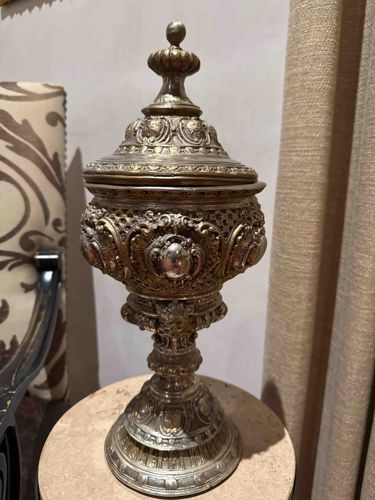
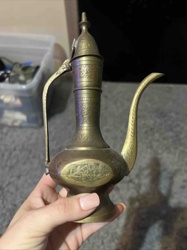
This is an elaborately decorated covered urn or jar, likely constructed from a metal such as silver, silver-plated metal, or possibly a bronze alloy with a silvered finish. The item exhibits a striking two-tone metallic appearance, with dominant silver-colored areas contrasted by recessed or highlighted sections in a gold or brass tone, suggesting either intentional dual-metal construction, selective plating, or a patination that emphasizes relief. The urn features a distinct Neoclassical or Baroque Revival style, characterized by its intricate rococo scrolling motifs, acanthus leaves, and prominent cartouche-like elements. The body of the urn is circular, widening from a narrower base to a broader mid-section before tapering slightly towards the neck where the lid rests. The lid itself is domed and equally ornate, topped with a finial composed of stacked, fluted, and spherical forms.
The central band of the urn's body is exceptionally detailed, showcasing multiple convex bosses or medallions, each framed by elaborate scrolling foliage and smaller circular accents. These medallions are highly reflective, suggesting a polished finish. The stem connecting the body to the base is substantial and also highly decorated with fluting, acanthus, and scrollwork, contributing to the item's overall grandeur. The circular footed base is tiered and features gadrooning or fluting along its lower edge, further emphasizing its decorative nature.
Observable condition issues include significant tarnish and oxidation, particularly in the recessed areas, which contribute to the 'antique' appearance. Some areas appear to have worn through the silvered finish, revealing a warmer, possibly brass or bronze, undertone, especially on high points and edges, suggesting long-term handling and age. There are no immediately visible dents or major structural damages, but a closer inspection would be required to confirm this. The craftsmanship appears to be of high quality, with intricate casting and chasing evident in the detailed motifs, indicating a skilled artisan. The overall impression is one of opulence and historical design influence, likely dating from the late 19th to early 20th century.
AI Appraisal Report
Upon visual examination of the provided image, this ornate covered urn presents as a fine example of Neoclassical or Baroque Revival decorative arts, likely dating from the late 19th to early 20th century. The intricate rococo scrolling, acanthus leaves, and prominent cartouche-like elements indicate a skilled artisan and a high level of craftsmanship, particularly in the casting and chasing of the motifs. Its two-tone metallic appearance, combining silver-colored areas with gold or brass-toned highlights, is a desirable feature, contributing to its opulent aesthetic.
Condition-wise, the urn exhibits significant tarnish and oxidation, which, while lending an antique patina, would benefit from professional cleaning to reveal its original luster. The wear to the silvered finish in high-contact areas, exposing a warmer undertone, is consistent with age and handling. I detect no immediate signs of major dents or structural damage from the image alone, although a hands-on inspection would be crucial to confirm this.
In the current market for decorative arts, items of this style and presumed quality maintain a steady demand, especially those that are elaborately detailed. Comparables would include similar metalware pieces from the Neoclassical or Revival periods, often fetching prices based on their material composition, intricacy, and overall condition. The size and impressive decorative impact of this urn would make it a focal point in a decorative setting. Factors impacting value positively include its elaborate design and apparent quality; negatively, the current tarnished state and the unknown base metal composition could affect its top-end value.
Limitations in authenticity verification from an image are considerable. While the style and craftsmanship appear consistent with the period, I cannot definitively determine the true metal composition (e.g., solid silver, silver-plated brass, bronze, etc.) or the exact manufacturing process without physical inspection. An in-person examination would allow for precise material identification through metallurgical testing, assessment of weight, and a thorough search for maker's marks or hallmarks, which are vital for full authentication and accurate valuation. Without these, the current appraisal is based on the visual attributes suggesting high-quality silver-plated or patinated base metal construction.