Paleolithic-Style Chert Bifacial Hand Axe
Prehistoric Lithic Artifacts

Paleolithic-Style Chert Bifacial Hand Axe

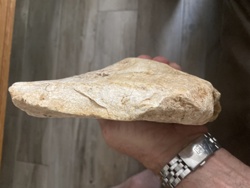
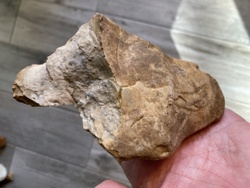
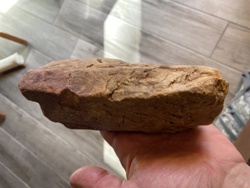
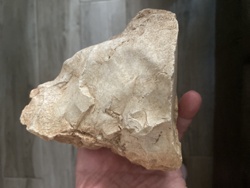
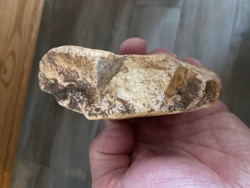
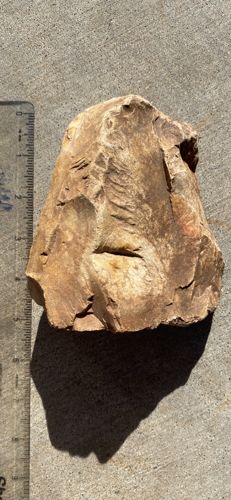
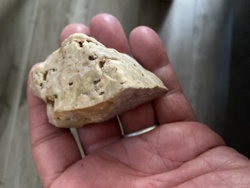
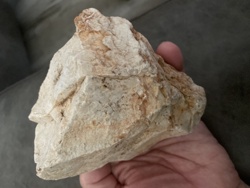
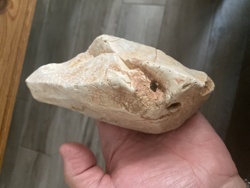
This specimen is a large lithic artifact identified as a bifacial hand axe, composed of local chert. The item measures approximately 13-14 centimeters in length, as indicated by the adjacent metric scale. It exhibits a roughly cordiform (heart-shaped) or triangular morphology, tapering from a broad, thick base to a more refined, though blunt, distal end. The material displays a variegated tan and ochre coloration, typical of weathered chert sourced in the Oklahoma region. Its construction is characterized by percussion flaking, evidenced by numerous negative flake scars across both faces and the lateral margins, which would have provided a serrated gripping or cutting edge. The surface shows significant evidence of environmental weathering and a heavy calcareous or mineral patina, suggesting a prehistoric age. There are no modern tool marks or signatures, which is consistent with early human lithic technology. The condition appears stable, though the edges show ancient micro-flaking and dulling from use or geological tumble. The craftsmanship indicates an intentional reduction sequence to create a versatile multi-tool for chopping, scraping, or butchery. Its provenance in Guthrie, OK, aligns with known Paleo-Indian or early Archaic sites in the Great Plains region.
Estimated Value

$450 - $700

Basic Information

Category

Prehistoric Lithic Artifacts

Appraised On

February 17, 2026

Estimated Value

$450 - $700

Additional Details Provided By Owner

User Provided Information

Prehistoric Paleolithic era chert hand axe found in Guthrie, OK on our property

Item Description

This specimen is a large lithic artifact identified as a bifacial hand axe, composed of local chert. The item measures approximately 13-14 centimeters in length, as indicated by the adjacent metric scale. It exhibits a roughly cordiform (heart-shaped) or triangular morphology, tapering from a broad, thick base to a more refined, though blunt, distal end. The material displays a variegated tan and ochre coloration, typical of weathered chert sourced in the Oklahoma region. Its construction is characterized by percussion flaking, evidenced by numerous negative flake scars across both faces and the lateral margins, which would have provided a serrated gripping or cutting edge. The surface shows significant evidence of environmental weathering and a heavy calcareous or mineral patina, suggesting a prehistoric age. There are no modern tool marks or signatures, which is consistent with early human lithic technology. The condition appears stable, though the edges show ancient micro-flaking and dulling from use or geological tumble. The craftsmanship indicates an intentional reduction sequence to create a versatile multi-tool for chopping, scraping, or butchery. Its provenance in Guthrie, OK, aligns with known Paleo-Indian or early Archaic sites in the Great Plains region.
Get Your Items Appraised

Instant estimates of your treasures with AI-powered instant appraisals

Browse More Appraisals