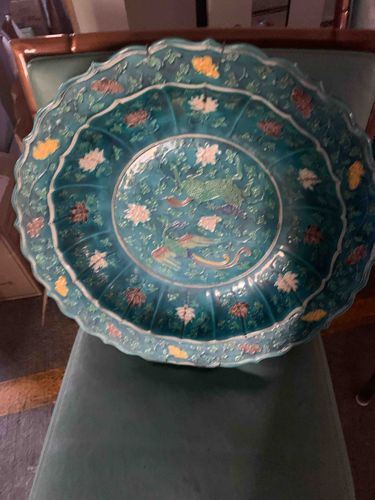
Large Kangxi-Style Turqoise-Ground Famille Verte Scalloped Charger
Asian Antiques - Chinese Ceramics

Large Kangxi-Style Turqoise-Ground Famille Verte Scalloped Charger

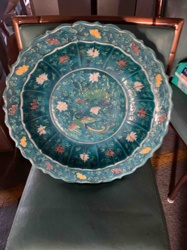
This is a large, ornate ceramic charger or deep plate, most likely crafted in the Kangxi style of Chinese porcelain. The item features a vibrant turquoise-green glazed ground with a highly decorative scalloped or 'pie-crust' rim. The central well depicts a traditional scene involving a phoenix and a qilin or deer-like mythological creature amidst floral sprays. This central motif is surrounded by a lobed cavetto and a wide border embellished with individual floral medallions and leaf patterns in a palette including yellow, white, and iron-red. The relief decoration suggests a 'f fahua' or similar slip-trail technique where the designs are raised above the base glaze. In terms of condition, there are visible chips along the delicate scalloped rim, specifically at the top twelve-o'-clock and four-o'-clock positions, which is common for ceramics of this age and complexity. The craquelure in the glaze and the specific tonal qualities of the enamels suggest a 19th-century or early 20th-century production, emulating the grander styles of the Qing Dynasty. The craftsmanship is high, evidenced by the rhythmic molding of the lobes and the multi-colored enameled details.
Estimated Value

$1,200 - $1,800 USD

Basic Information

Category

Asian Antiques - Chinese Ceramics

Appraised On

January 14, 2026

Estimated Value

$1,200 - $1,800 USD

Item Description

This is a large, ornate ceramic charger or deep plate, most likely crafted in the Kangxi style of Chinese porcelain. The item features a vibrant turquoise-green glazed ground with a highly decorative scalloped or 'pie-crust' rim. The central well depicts a traditional scene involving a phoenix and a qilin or deer-like mythological creature amidst floral sprays. This central motif is surrounded by a lobed cavetto and a wide border embellished with individual floral medallions and leaf patterns in a palette including yellow, white, and iron-red. The relief decoration suggests a 'f fahua' or similar slip-trail technique where the designs are raised above the base glaze. In terms of condition, there are visible chips along the delicate scalloped rim, specifically at the top twelve-o'-clock and four-o'-clock positions, which is common for ceramics of this age and complexity. The craquelure in the glaze and the specific tonal qualities of the enamels suggest a 19th-century or early 20th-century production, emulating the grander styles of the Qing Dynasty. The craftsmanship is high, evidenced by the rhythmic molding of the lobes and the multi-colored enameled details.

Get Your Items Appraised

Instant estimates of your treasures with AI-powered instant appraisals

Browse More Appraisals