Mid-Century Israeli Neo-Ancient Verdigris Bronze Menorah Pitcher
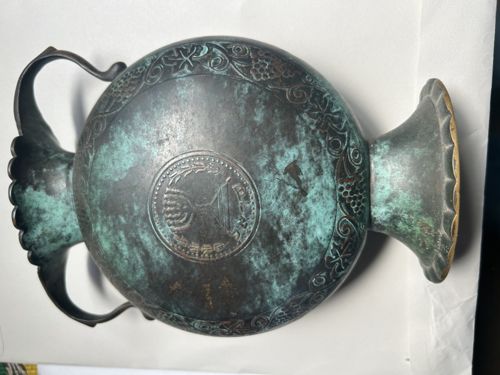
This decorative brass or bronze pitcher is a quintessential example of mid-20th-century Israeli 'Neo-Ancient' or souvenir art, likely manufactured between 1950 and 1970. The vessel features a flattened, disc-shaped body (ampulla silhouette) with a flared scalloped rim and a matching pedestal foot. Elaborate scrolled handles are attached to the neck. The surface is treated with a heavy, artificially applied green verdigris patina to mimic archaeological artifacts recovered from the Mediterranean. Centered on the body is a circular repoussé emblem featuring a seven-branched Menorah, referencing the State of Israel emblem. The central motif is surrounded by a raised border of grapevine clusters and scrolling foliage, a common motif in Biblical and Zionist art. The craftsmanship displays die-stamped or cast elements joined by soldering. Condition-wise, the piece appears structurally sound with intentional mottling in the patina; however, there is some uneven wear and surface scratching that reveals the warm yellow metal beneath the green finish. The scalloped edges show minor irregular wear consistent with age and display but no significant structural deformation. This style of metalwork was popularized by companies like Oppenheim or Nordia in the early decades of the State of Israel.
AI-Generated Appraisal Disclaimer
Estimated Value
$125.00 - $175.00
Basic Information
Category
Judaica / Decorative Arts
Appraised On
February 22, 2026
Estimated Value
$125.00 - $175.00
Additional Details Provided By Owner
User Provided Information
Neo-ancient revival/Judaica souvenir style. The flattened amphora/ampulla silhouette with scalloped rim and foot evokes classical forms, while the repoussé grape clusters and menorah emblem reference biblical motifs and the modern State of Israel emblem. Patina appears intentionally applied to mimic archaeological bronze. made in Israel
Item Description
This decorative brass or bronze pitcher is a quintessential example of mid-20th-century Israeli 'Neo-Ancient' or souvenir art, likely manufactured between 1950 and 1970. The vessel features a flattened, disc-shaped body (ampulla silhouette) with a flared scalloped rim and a matching pedestal foot. Elaborate scrolled handles are attached to the neck. The surface is treated with a heavy, artificially applied green verdigris patina to mimic archaeological artifacts recovered from the Mediterranean. Centered on the body is a circular repoussé emblem featuring a seven-branched Menorah, referencing the State of Israel emblem. The central motif is surrounded by a raised border of grapevine clusters and scrolling foliage, a common motif in Biblical and Zionist art. The craftsmanship displays die-stamped or cast elements joined by soldering. Condition-wise, the piece appears structurally sound with intentional mottling in the patina; however, there is some uneven wear and surface scratching that reveals the warm yellow metal beneath the green finish. The scalloped edges show minor irregular wear consistent with age and display but no significant structural deformation. This style of metalwork was popularized by companies like Oppenheim or Nordia in the early decades of the State of Israel.
Get Your Items Appraised
Instant estimates of your treasures with AI-powered instant appraisals