AI estimate as of October 23, 2025 · verify with a professional before acting
AI-Generated · Verify before acting
Everything on this page is generated by AI for informational purposes only. AI can make mistakes — the AI may misidentify items or misattribute them (artist, maker, brand, designer, origin, era). This is not an official valuation and should not be used for insurance, sale, tax, estate, legal, or lending purposes — or any decision requiring a certified appraisal. It is not an authoritative claim about any person, brand, or rights holder — do not share or rely on it as a factual statement about a third party. Always consult qualified professionals before making financial decisions.
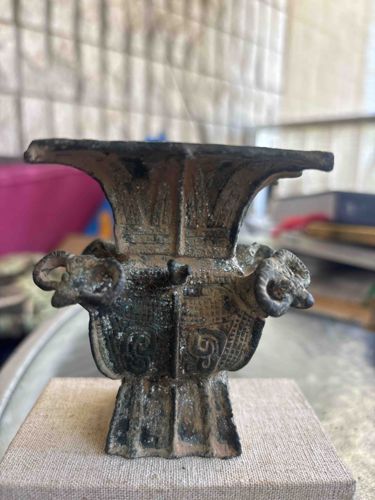
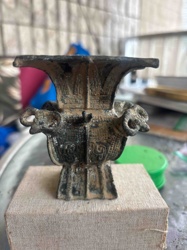
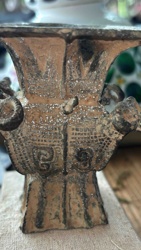
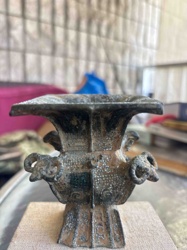
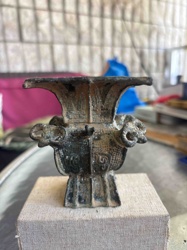
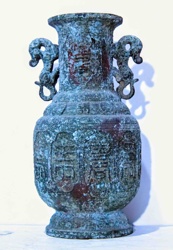
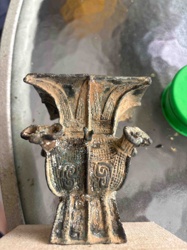
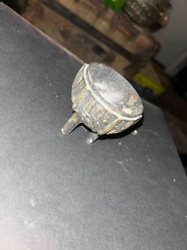
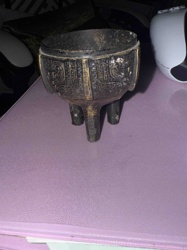
This is an ancient Chinese bronze ritual vessel, likely a zun or hu type, characterized by its substantial form and intricate decorative elements. The vessel is constructed from bronze, exhibiting a dark, mottled patination with areas of lighter green and brown corrosion, indicative of significant age and exposure to environmental factors. Its form features a flared mouth, a relatively short neck, a bulbous central body, and a splayed foot. The most striking features are the two zoomorphic handles in the form of ram's heads, complete with coiled horns and distinct facial features, protruding from opposing sides of the vessel's shoulder. The body is extensively decorated with relief patterns, possibly depicting taotie masks or abstract geometric motifs in segmented panels. The quality of casting appears robust, though some details are obscured by the heavily corroded surface. The relief work on the body and neck suggests a sophisticated level of craftsmanship for its period, with clear lines despite the wear. There are visible signs of wear and corrosion across the entire surface, including pitting and loss of finer details, particularly on the raised decorative elements and around the rim and foot. No distinct maker's marks or signatures are discernible from the image. Based on its style, material, and decoration, it is likely from the Shang or Zhou Dynasty, placing its estimated age anywhere from 1000 BC to 256 BC. The heavy patination and typical form indicate its authenticity as an archaeological artifact.
AI Appraisal Report
Based on my visual examination of the provided image, this ancient Chinese bronze ritual vessel, likely a 'zun' or 'hu' type, exhibits characteristics consistent with artifacts from the Shang or early Western Zhou Dynasty (roughly 1600-771 BC). The substantial form, the dark, mottled patination with areas of green and brown corrosion, and the typical flared mouth, bulbous body, and splayed foot are all hallmarks of authentic ancient Chinese bronzes. The most compelling features are the two zoomorphic ram's head handles, demonstrating a high degree of artistic sophistication and casting quality for the period. The intricate relief patterns, likely depicting 'taotie' masks or geometric motifs, further support this attribution.
The condition, while showing significant wear, pitting, and corrosion - particularly on raised elements and edges - is typical for an archaeological artifact of this age, indicating genuine burial and environmental exposure rather than artificial aging. The robustness of the original casting is still evident beneath the heavy patination. This vessel's age, intricate design, and ritualistic purpose contribute to its rarity and high demand among collectors of ancient Chinese art.
Market conditions for authentic Shang and Zhou bronzes are strong, with significant demand for pieces of this quality and type. Comparable pieces with similar decorative elements and states of preservation have achieved substantial prices at international auctions. Factors impacting value positively include the vessel's likely age, the distinctive ram's head handles, and the overall aesthetic appeal. The heavy corrosion, while authenticating, does obscure some finer details, which slightly impacts the upper end of the valuation.
It is crucial to note the limitations of authenticating such a significant artifact solely from images. A definitive authenticity verification would require in-person examination to assess the bronze alloy composition, casting methods, and detailed surface characteristics not fully discernible in photographs. Furthermore, provenance documentation detailing the vessel's history and scientific testing (e.g., X-ray fluorescence, thermoluminescence) would be essential for full authentication and to achieve the highest possible market value.