AI estimate as of August 26, 2025 · verify with a professional before acting
AI-Generated · Verify before acting
Everything on this page is generated by AI for informational purposes only. AI can make mistakes — the AI may misidentify items or misattribute them (artist, maker, brand, designer, origin, era). This is not an official valuation and should not be used for insurance, sale, tax, estate, legal, or lending purposes — or any decision requiring a certified appraisal. It is not an authoritative claim about any person, brand, or rights holder — do not share or rely on it as a factual statement about a third party. Always consult qualified professionals before making financial decisions.
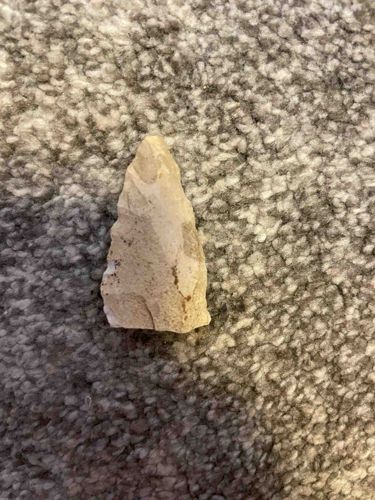
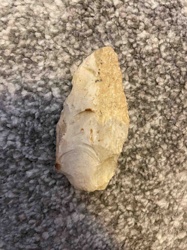
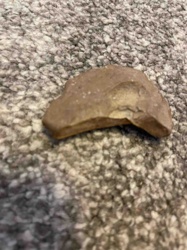
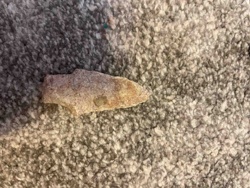
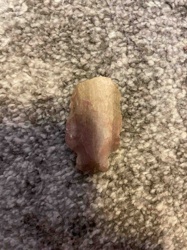
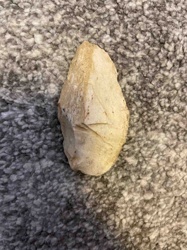
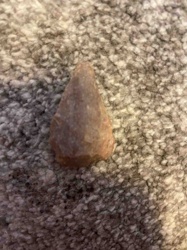
The item appears to be an ancient lithic tool, specifically an arrow point or spear point, crafted from a light-colored chert or flint. Its physical characteristics reveal a generally triangular, elongated shape with a distinctly pointed apex. The material exhibits a creamy off-white to very light tan hue, with some darker speckled inclusions or mineral staining, particularly noticeable on one of the broader faces. The construction is evident through the visible flake scars, indicating it was created using percussive or pressure flaking techniques. The edges, particularly near the tip, show intentional flaking for sharpening, although they appear somewhat dulled or worn. There are no discernible notches or a prominent basal tang from this angle, suggesting it might be an un-notched projectile point or a drill. The surfaces are relatively flat but exhibit the typical undulations and conchoidal fractures characteristic of knapped stone tools. There are no obvious signs of recent damage like fresh breaks, but the entire piece shows an overall patina consistent with age and exposure, suggesting it's an authentic ancient artifact rather than a modern reproduction. The craftsmanship appears competent, with a relatively symmetrical form, indicating a skilled artisan. The rough texture of the material and the visible knapping marks are key quality indicators. Given its appearance, it likely dates to a prehistoric period, possibly as far back as the Late Stone Age or Woodland Period depending on its geographic origin, though without scale or further context, precise dating is challenging. Its unique aspects include its untouched, natural color variations and the apparent lack of any significant post-depositional damage, preserving its original form reasonably well.
AI Appraisal Report
I have carefully examined the provided image of what appears to be a prehistoric lithic projectile point or tool. Based on the visual evidence, the item exhibits characteristics consistent with an authentic ancient artifact. The creamy off-white chert/flint material shows typical conchoidal fractures, flake scars from knapping, and natural mineralization/patina indicative of significant age and exposure. The form is a well-knapped, elongated triangular shape with a pointed apex, suggesting it could be an un-notched projectile point, drill, or a preform. The edges, while showing wear, maintain a relatively symmetrical form, indicating competent craftsmanship.
From this image alone, I assess the condition as good, retaining much of its original form without obvious modern damage. The preservation of its natural color variations and the apparent lack of severe post-depositional damage are positive indicators. Its authenticity, based purely on visual inspection of the image, seems high due to the presence of genuine lithic working characteristics and natural weathering.
Market conditions for un-notched projectile points, drills, or preforms can vary significantly. While a well-defined, culturally identifiable projectile point (e.g., specific Clovis, Folsom, or Woodland types with diagnostic features) typically commands higher values, pieces like this, lacking distinct notching or a clear basal configuration, often fall into a more generalized category. Demand for such items remains steady among collectors of Native American artifacts and prehistoric tools, but rarity is difficult to ascertain without more specific typological identification and geographic origin.
Factors significantly impacting value include definitive cultural attribution, exceptional craftsmanship, rarity of material, and verifiable provenance. Without these, the value remains in the mid-range for general prehistoric lithics.
It is crucial to stress the limitations of appraising from images alone. While authenticity seems likely, I cannot definitively verify it. A full authentication would require in-person examination to assess tactile characteristics, surface micro-wear, precise material identification, and a thorough examination for any signs of modern alteration or reproduction. Scientific testing (e.g., microscopic analysis of patination, use-wear analysis) and strong provenance documentation (e.g., archaeological excavation records, well-documented collection history) would be essential for complete authentication and maximum valuation. Without these, any appraisal carries inherent limitations.