AI Appraisal Estimate

AI-generated estimates · not official valuations

From the user

What was submitted

Photo and notes provided by the user — not generated by AI

Submitted item photo
Submitted photo · June 19, 2026

User's notes

No additional notes provided.

AI analysis below

AI appraisal

AI analysis & estimate

AI-Generated · Verify before acting

Everything below is generated by AI for informational purposes only. AI can make mistakes — the AI may misidentify items or misattribute them (artist, maker, brand, designer, origin, era). This is not an official valuation and should not be used for insurance, sale, tax, estate, legal, or lending purposes — or any decision requiring a certified appraisal. It is not an authoritative claim about any person, brand, or rights holder — do not share or rely on it as a factual statement about a third party. Always consult qualified professionals before making financial decisions.

Read the full disclaimer

AI Identification

·Not independently authenticated·Verify before acting

Royal Crown Derby Imari-Style Porcelain Cabinet Plate

Fine Ceramics and Porcelain

AI Estimated Value

·Not an official valuation·Verify before acting

$150-$250

As of June 19, 2026

AI Item Analysis

·AI can make mistakes·Verify before acting
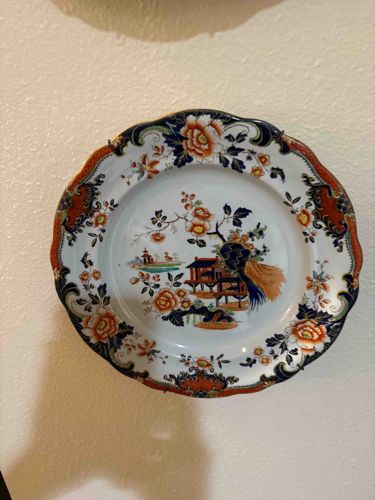
This is a decorative porcelain cabinet plate featuring a traditional Imari-style palette of iron red, cobalt blue, and gold accents on a white ground. The plate has a distinctively scalloped rim with a deep cobalt blue border intricately decorated with gilded floral motifs and rust-colored cartouches. The central medallion depicts a classic Chinoiserie scene, including a pagodas, stylized flora, and a prominent bird, likely a peacock, perched on a branch. The craftsmanship suggests a high-quality bone china or ironstone construction, common in English potteries such as Royal Crown Derby or Spode during the late 19th to early 20th century. The hand-painted details show fine line work and layered glazes, indicating a high level of artisanal skill. Regarding condition, the plate appears to be well-preserved while mounted on a wall; however, minor surface abrasions, localized gilt loss along the scalloped edges, and faint crazing consistent with a piece of this age are likely present upon close inspection. The colors remain vibrant, particularly the deep blues and oranges. There are no obvious chips or cracks visible from this perspective, suggesting it has been used primarily for display. This style of 'Old Imari' was highly popular during the Victorian and Edwardian eras as a Western interpretation of Japanese porcelain aesthetics.
AI Appraisal Report

·AI can make mistakes·Verify before acting
Based on my visual examination of the provided images, this piece presents as a late 19th to early 20th-century English porcelain cabinet plate, heavily influenced by the Japanese Imari aesthetic which was popularized by firms like Royal Crown Derby and Davenport. The plate features the characteristic iron red, cobalt blue, and heavy 22k gold gilding known as the 'Old Imari' or 'Kings' pattern style. The central Chinoiserie medallion and scalloped rim with alternating cobalt and rouge-de-fer panels are classic indicators of high-quality English production from the Victorian or Edwardian eras. The condition appears generally very good for its age, with vibrant color retention and intact structural integrity. I note no visible hairlines or major chips. However, as is common with plates of this vintage, there is likely minor gilt rubbing on the high points of the scalloped rim and potential light crazing in the glaze which photographs may obscure. The market for Traditional Imari wares has softened slightly from its peak but remains stable for high-quality examples. While Royal Crown Derby is the most prestigious maker in this style, similar examples were produced by Mason's or Spode. To confirm the higher end of the valuation or attribution specifically to Royal Crown Derby, I would need to physically inspect the maker's mark (backstamp) on the reverse, which is not visible here. Without confirming the specific factory date cipher or pattern number (e.g., pattern 1128), I must appraise this conservatively as a high-quality period Imari-style cabinet plate rather than a confirmed rare prototype. Authenticity seems highly probable given the fidelity of the palette and the complexity of the transfer and hand-painted elements.

Get your items appraised

Instant estimates of your treasures with AI-powered appraisals

Browse More Appraisals