Prehistoric Hammerstone / Core Tool
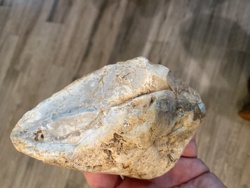
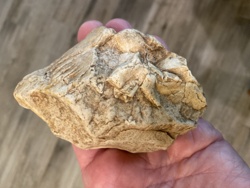
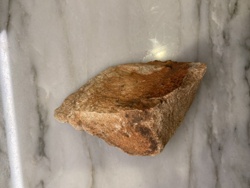
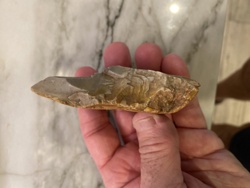
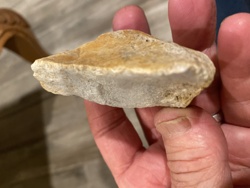
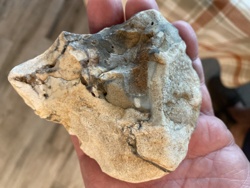
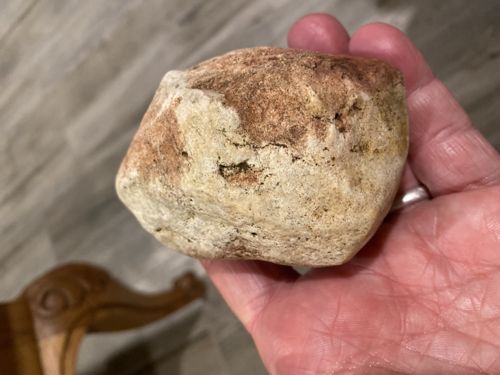
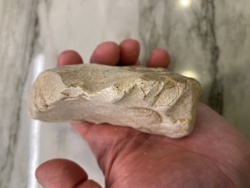
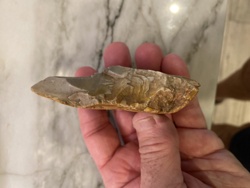
This artifact is a prehistoric lithic tool, specifically a hammerstone or core tool, originating from the Guthrie, Oklahoma area. Measuring approximately 3 inches by 2.25 inches, the item fits comfortably in the palm of a hand, suggesting an ergonomic design for manual percussion tasks. The material appears to be a dense, microcrystalline silica-based rock, such as chert or a hard quartzite, which was favored for its durability. The stone exhibits a bi-tonal color profile, featuring a cream-to-off-white base with significant reddish-brown iron-oxide staining or hematite patina across its upper surface. Noteworthy physical characteristics include multiple flaked facets along the edges, indicative of intentional reduction or use-wear. The surface shows distinct 'pecking' or impact crushing on the convex ridges, a hallmark of a hammerstone used to strike other stones during the flintknapping process. There is a visible porous texture in certain recessed areas, possibly representing the original cortex of the cobble. Condition-wise, the tool shows thousands of years of natural weathering and soil staining, but the primary structural integrity remains excellent with no modern fractures. The craftsmanship is utilitarian rather than aesthetic, reflecting a tool used in the manufacture of other projectile points or scrapers during the Stone Age, potentially dating from the Archaic to the Woodland period.
AI-Generated Appraisal Disclaimer
Estimated Value
$40 - $75
Basic Information
Category
Archaeological Artifacts / Native American Lithics
Appraised On
February 18, 2026
Estimated Value
$40 - $75
Additional Details Provided By Owner
User Provided Information
Stone age core hammer stone tool found in Guthrie Ok 3" x 2.25
Item Description
This artifact is a prehistoric lithic tool, specifically a hammerstone or core tool, originating from the Guthrie, Oklahoma area. Measuring approximately 3 inches by 2.25 inches, the item fits comfortably in the palm of a hand, suggesting an ergonomic design for manual percussion tasks. The material appears to be a dense, microcrystalline silica-based rock, such as chert or a hard quartzite, which was favored for its durability. The stone exhibits a bi-tonal color profile, featuring a cream-to-off-white base with significant reddish-brown iron-oxide staining or hematite patina across its upper surface. Noteworthy physical characteristics include multiple flaked facets along the edges, indicative of intentional reduction or use-wear. The surface shows distinct 'pecking' or impact crushing on the convex ridges, a hallmark of a hammerstone used to strike other stones during the flintknapping process. There is a visible porous texture in certain recessed areas, possibly representing the original cortex of the cobble. Condition-wise, the tool shows thousands of years of natural weathering and soil staining, but the primary structural integrity remains excellent with no modern fractures. The craftsmanship is utilitarian rather than aesthetic, reflecting a tool used in the manufacture of other projectile points or scrapers during the Stone Age, potentially dating from the Archaic to the Woodland period.
Get Your Items Appraised
Instant estimates of your treasures with AI-powered instant appraisals