AI Appraisal Estimate

AI-generated estimates · not official valuations

From the user

What was submitted

Photo and notes provided by the user — not generated by AI

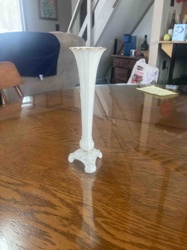
Submitted item photo
Submitted photo · June 12, 2026

User's notes

No additional notes provided.

AI analysis below

AI appraisal

AI analysis & estimate

AI-Generated · Verify before acting

Everything below is generated by AI for informational purposes only. AI can make mistakes — the AI may misidentify items or misattribute them (artist, maker, brand, designer, origin, era). This is not an official valuation and should not be used for insurance, sale, tax, estate, legal, or lending purposes — or any decision requiring a certified appraisal. It is not an authoritative claim about any person, brand, or rights holder — do not share or rely on it as a factual statement about a third party. Always consult qualified professionals before making financial decisions.

Read the full disclaimer

AI Identification

·Not independently authenticated·Verify before acting

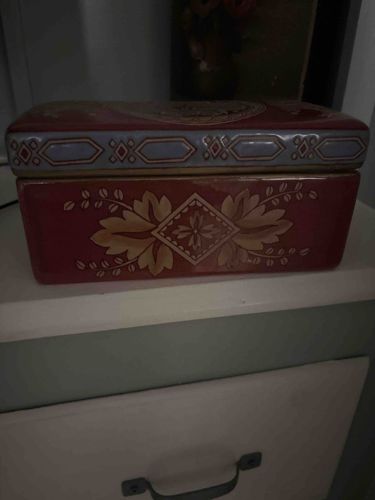
Vintage Sèvres-Style Ceramic Trinket or Vanity Box

Decorative Arts - Ceramics

AI Estimated Value

·Not an official valuation·Verify before acting

$45.00-$65.00

As of June 12, 2026

AI Item Analysis

·AI can make mistakes·Verify before acting
This is a rectangular ceramic trinket or vanity box, likely dating from the mid-20th century. The piece features a deep burgundy or maroon base glaze on the body and the lid. The front panel of the base is decorated with a transfer-printed or hand-painted botanical motif in a muted buff-ochre color, consisting of a central diamond-shaped floral crest flanked by acanthus-style leaves and delicate sprigs. The lid has a raised, stepped profile with a light-blue or periwinkle border containing a geometric pattern of elongated hexagons and diamonds. This decorative molding suggests a mid-century interpretation of French Neoclassical or Empire styles. The box appears to be constructed of a kiln-fired ceramic, possibly earthenware or stoneware, with a high-gloss finish. Regarding condition, there is a visible chip or loss of glaze on the lower-left corner of the lid's border, and the alignment of the lid to the base shows slight unevenness, common in mass-produced decorative ceramics. No specific maker’s mark is visible in the provided angle, but the style is characteristic of European export ware (French or Italian) or higher-quality Japanese ceramics from the 1960s. The interior is likely unglazed or white-glazed for utility. The overall craftsmanship displays intentional symmetry and a rich color palette suitable for a traditional dressing table or mantle.
AI Appraisal Report

·AI can make mistakes·Verify before acting
I have conducted a visual examination of this ceramic trinket box, which exhibits the stylistic hallmarks of mid-20th-century decorative export ware. The deep burgundy glaze and geometric periwinkle border suggest a mid-century interpretation of Sèvres-style Neoclassicism. While the central motif mimics hand-painting, the uniformity of the acanthus-style leaves indicates a high-quality transfer-print technique common in 1950s-60s European or Japanese production for the Western market. The condition is fair to good; however, the visible loss of glaze on the lower-left corner of the lid and the slight misalignment between the lid and base are significant detriments. Such defects are common in mass-produced earthenware and suggest this was a commercial decorative piece rather than a studio-crafted or fine porcelain item. The market for secondary mid-century vanity accessories is currently stable but saturated. Comparable items by manufacturers like Limoges (if marked) or high-end Japanese exporters typically realize prices in the $40 to $80 range at auction. The lack of a visible maker's mark and the surface damage limit the upper valuation. It is essential to note that this appraisal is based on photographic evidence only. A definitive valuation would require an in-person inspection to determine the body's porosity and examine the underside for backstamps. Scientific testing such as UV light examination would be necessary to identify any hidden structural repairs, and provenance documentation would be required to elevate the piece beyond a generic decorative classification.

Get your items appraised

Instant estimates of your treasures with AI-powered appraisals

Browse More Appraisals