Chopper-Style Prehistoric Lithic Tool / Hand Axe
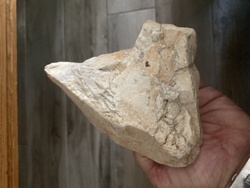
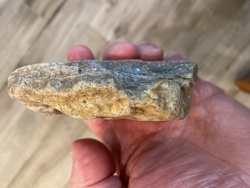
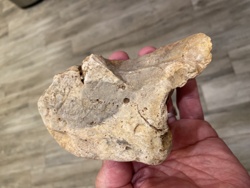
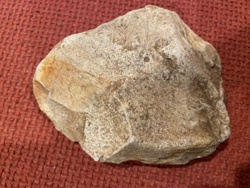
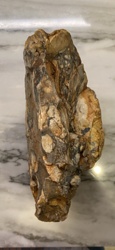
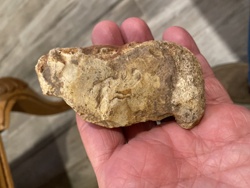
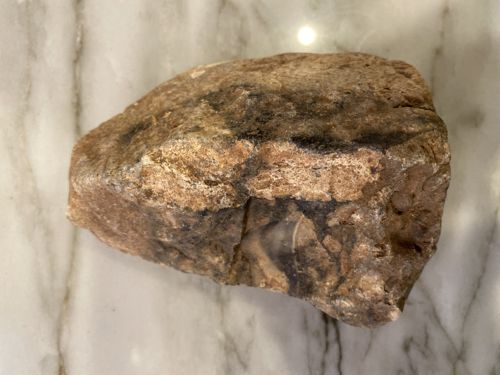
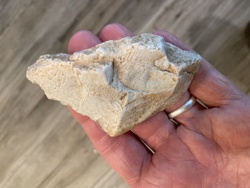
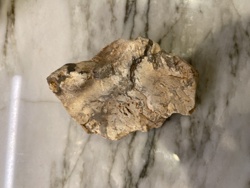
This item is a prehistoric lithic tool, commonly referred to as a hand axe or chopper, discovered in Guthrie, Oklahoma. The artifact is constructed from a dense, crypto-crystalline silicate material, likely a local variety of chert or flint, showing a rugged, weathered exterior with a distinct earthen patina. Its coloration ranges from light tan and cream-colored cortex to darker, charcoal-gray and deep brown interior exposures where the material has been knapped. The tool features a bulky, somewhat plano-convex shape with a thick, rounded butt end designed to fit comfortably in the palm of a hand. One edge shows evidence of unifacial or crude bifacial percussion flaking to create a heavy working surface. Notable is a large, concave flake scar near the center-right showing a smoother, darker interior texture. There are no visible maker's marks, as is typical for Paleolithic or Archaic tools. Condition-wise, the specimen shows significant environmental wear, including mineral staining and calcification typical of long-term burial in Oklahoma soil. The edges are blunted from ancient use or post-depositional weathering. The craftsmanship is utilitarian, representing an early stage of lithic technology where the focus was on the functionality of the edge rather than refined symmetry. This piece serves as a significant example of early human tool-making in the North American Plains region.
AI-Generated Appraisal Disclaimer
Estimated Value
$40-$75
Basic Information
Category
Archaeological Artifacts / Prehistoric Stone Tools
Appraised On
February 18, 2026
Estimated Value
$40-$75
Additional Details Provided By Owner
User Provided Information
Prospect prehistoric hand axe found in Guthrie, OK
Item Description
This item is a prehistoric lithic tool, commonly referred to as a hand axe or chopper, discovered in Guthrie, Oklahoma. The artifact is constructed from a dense, crypto-crystalline silicate material, likely a local variety of chert or flint, showing a rugged, weathered exterior with a distinct earthen patina. Its coloration ranges from light tan and cream-colored cortex to darker, charcoal-gray and deep brown interior exposures where the material has been knapped. The tool features a bulky, somewhat plano-convex shape with a thick, rounded butt end designed to fit comfortably in the palm of a hand. One edge shows evidence of unifacial or crude bifacial percussion flaking to create a heavy working surface. Notable is a large, concave flake scar near the center-right showing a smoother, darker interior texture. There are no visible maker's marks, as is typical for Paleolithic or Archaic tools. Condition-wise, the specimen shows significant environmental wear, including mineral staining and calcification typical of long-term burial in Oklahoma soil. The edges are blunted from ancient use or post-depositional weathering. The craftsmanship is utilitarian, representing an early stage of lithic technology where the focus was on the functionality of the edge rather than refined symmetry. This piece serves as a significant example of early human tool-making in the North American Plains region.
Get Your Items Appraised
Instant estimates of your treasures with AI-powered instant appraisals