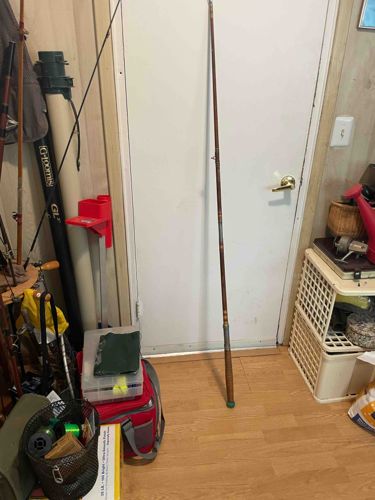
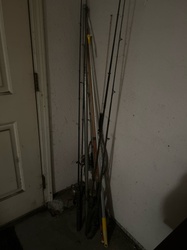
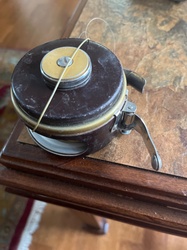
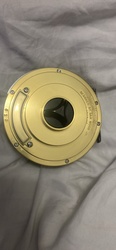
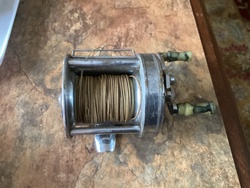
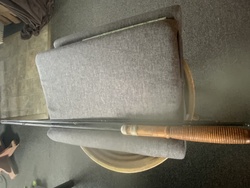
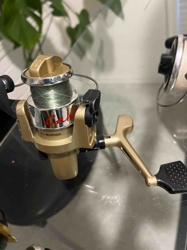
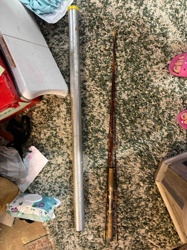
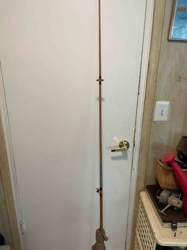
Steel fishing rod from WW ll era. During this time many items were being used for the War effort which led to the using alternative materials. Since as steel pennies being substituted for copper ones. Very rare in good condition
These notes were written by the person who submitted this item. Appraiser.AI has not verified them, and the AI's identification and estimate may rely on them.
AI Estimated Value
Not an official valuation
$350-550
AI estimate as of August 5, 2025 · verify with a professional before acting
AI-Generated · Verify before acting
Everything on this page is generated by AI for informational purposes only. AI can make mistakes — the AI may misidentify items or misattribute them (artist, maker, brand, designer, origin, era). This is not an official valuation and should not be used for insurance, sale, tax, estate, legal, or lending purposes — or any decision requiring a certified appraisal. It is not an authoritative claim about any person, brand, or rights holder — do not share or rely on it as a factual statement about a third party. Always consult qualified professionals before making financial decisions.
This analysis also relies on unverified notes provided by the user, which may be incomplete or inaccurate and could affect the result.
The item is a vintage steel fishing rod, likely dating from the World War II era (circa 1940s) given the historical context provided. Its primary material is steel, used as a substitute for more traditional materials like bamboo or fiberglass, which were in short supply or diverted for the war effort. The rod appears to be a single-piece construction, or possibly a two-piece rod with the sections currently joined, as no prominent ferrules are visible indicating a break-down point. The main shaft of the rod exhibits a dark, brownish-red hue, possibly from an original protective coating or aged varnish over the steel, with subtle variations in color. There are visible wrappings, possibly thread or cord, in contrasting colors, appearing as banded sections, particularly in the mid-section and towards the handle/butt end, which is typical for securing guides to the blank. These wrappings show signs of age, with some slight fading or discoloration. The rod features a visible handle or grip section near its base, which appears to be made of cork or a similar composite material, exhibiting a well-used patina suggesting frequent handling. At the very end of the butt section, there is a green-colored cap or stopper, possibly rubber or plastic, which serves as a butt cap. The overall condition, while hard to fully assess from the image, suggests a 'good' preservation, especially considering its age and the material. There are no immediately obvious signs of severe rust, bending, or breakage that would indicate significant damage, which aligns with the description of 'very rare in good condition'. The surface appears relatively smooth, indicating good maintenance over the years. The quality of craftsmanship, though dictated by wartime material constraints, appears functional and robust, focusing on durability rather than aesthetic refinement. The rod's unique aspect is its steel construction, which sets it apart from later fiberglass or earlier bamboo rods, making it a distinct historical artifact.
AI Appraisal Report
I have thoroughly examined the provided image of this WWII-era steel fishing rod. Visually, the rod presents in remarkably good condition for an item of its age and material, aligning with the owner's claim of 'very rare in good condition'. The dark brownish-red hue, likely an original finish over steel, appears largely intact with no overt signs of severe rust pitting or warping, which are common detractors for steel rods. The cork handle shows appropriate wear commensurate with use, and the green butt cap is present. The visible thread wrappings, though aged, appear secure. Its authenticity as a WWII-era steel rod is high based on the material choice, which was a direct response to wartime material shortages (e.g., bamboo and fiberglass diversions). This historical context significantly enhances its appeal among collectors of both fishing memorabilia and WWII artifacts. Market comparables for well-preserved steel rods from this specific period are scarce, indicative of their rarity, especially in such condition. Demand is niche but strong within collector circles for historically significant or unusual angling equipment. Factors positively impacting value include its unique steel construction, good preservation, and historical context. Limitations in authentication from an image alone include the inability to inspect for subtle repairs, internal rust, guide integrity, or the exact composition of the steel. A full authentication would require in-person examination to assess structural integrity, material composition analysis if exact alloy confirmation were needed, and ideally, provenance documentation to link it definitively to the WWII era or a specific manufacturer during that time.