AI Appraisal Estimate

AI-generated estimates · not official valuations

From the user

What was submitted

Photo and notes provided by the user — not generated by AI

Submitted item photo
Submitted photo · June 12, 2026

User's notes

No additional notes provided.

AI analysis below

AI appraisal

AI analysis & estimate

AI-Generated · Verify before acting

Everything below is generated by AI for informational purposes only. AI can make mistakes — the AI may misidentify items or misattribute them (artist, maker, brand, designer, origin, era). This is not an official valuation and should not be used for insurance, sale, tax, estate, legal, or lending purposes — or any decision requiring a certified appraisal. It is not an authoritative claim about any person, brand, or rights holder — do not share or rely on it as a factual statement about a third party. Always consult qualified professionals before making financial decisions.

Read the full disclaimer

AI Identification

·Not independently authenticated·Verify before acting

Antique Bronzed Cast Metal Cavalier Figurine

Antique Sculpture and Decorative Arts

AI Estimated Value

·Not an official valuation·Verify before acting

$450 - $650

As of June 12, 2026

AI Item Analysis

·AI can make mistakes·Verify before acting
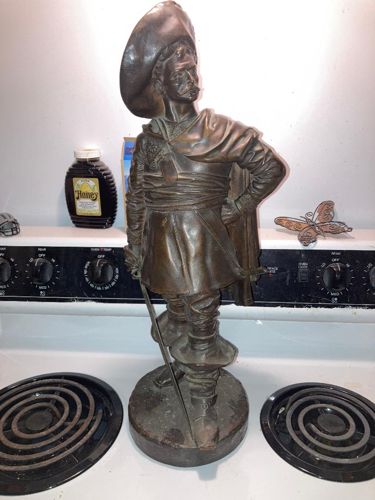
This is a large cast metal statuette depicting a 17th-century style European Cavalier or Musketeer. The figure stands in a proud, dynamic contrapposto pose, wearing a wide-brimmed floppy hat, a tunic with a heavy sash, wide-cuffed bucket boots, and a flowing cape draped over the left shoulder. The right hand rests on a long rapier sword that extends to the circular plinth base. The piece features a deep brown, almost black, patinated bronze finish over what appears to be white metal (likely spelter or pot metal), common in late 19th to early 20th-century decorative arts. The craftsmanship shows intricate detailing in the folds of the garments, the facial hair, and the texture of the sash. The circular base is integral to the casting and shows significant wear along the edges. Visible condition issues include some loss of the dark bronzed finish on high-relief points like the toe of the boot and the brim of the hat, revealing a lighter metal underneath. There is surface dust, minor scratches, and potential slight bending of the sword blade. No maker's marks are immediately visible in the image, but the style is consistent with French or European 'Troubadour style' Romanticism from the 1880-1910 period.
AI Appraisal Report

·AI can make mistakes·Verify before acting
I have virtually examined this large 17th-century style cavalier figurine, a quintessential example of the late 19th-century French 'Troubadour style.' Based on the visual evidence of finish wear on high-relief points revealing a lighter substrate, I have identified this as cold-painted or bronzed spelter (zinc alloy) rather than solid bronze. This was a common manufacturing technique between 1880 and 1910 to cater to the growing middle-class demand for heroic, romanticized historical decor. The condition is fair to good for its age. The wear on the boot and hat brim, while typical, slightly detracts from the value as the dark patina is the piece's primary aesthetic appeal. The potential bending of the sword is a common fragility in spelter castings from this era. In the current decorative arts market, spelter figures have seen a plateau in value compared to their bronze counterparts, though large-scale examples with dynamic posing like this remain popular with collectors of military and period-specific memorabilia. Comparables for mass-produced French spelter figures of this size and subject matter typically hammer between $400 and $700 at regional auctions. Factors limiting the value include the lack of a visible foundry mark (such as Moreau or Rancoulet) and the condition of the base edges. Critically, this appraisal is based on image analysis; a physical inspection is required to check for structural cracks (zinc pest) and to verify the weight and resonance of the metal. Full authentication would require an in-person search for hidden signatures beneath the patina or on the underside of the base, as well as provenance documentation to confirm its origins as an authentic 19th-century casting rather than a mid-20th-century reproduction.

Get your items appraised

Instant estimates of your treasures with AI-powered appraisals

Browse More Appraisals