AI estimate as of October 24, 2025 · verify with a professional before acting
AI-Generated · Verify before acting
Everything on this page is generated by AI for informational purposes only. AI can make mistakes — the AI may misidentify items or misattribute them (artist, maker, brand, designer, origin, era). This is not an official valuation and should not be used for insurance, sale, tax, estate, legal, or lending purposes — or any decision requiring a certified appraisal. It is not an authoritative claim about any person, brand, or rights holder — do not share or rely on it as a factual statement about a third party. Always consult qualified professionals before making financial decisions.
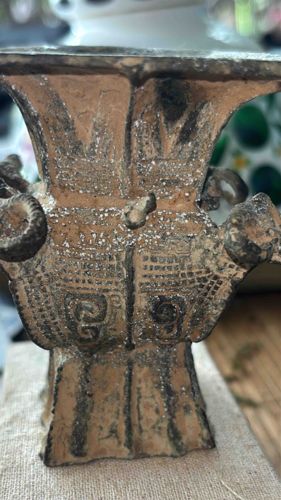
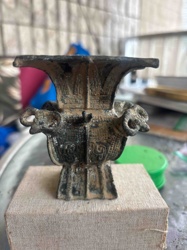
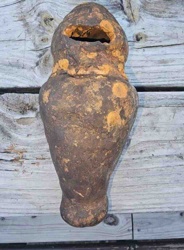
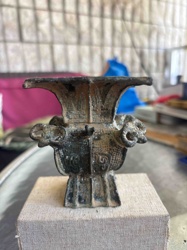
The item appears to be an archaic Chinese bronze ritual vessel, likely a 'Gu' or a vessel sharing similar stylistic elements of an upright beaker. It is constructed from a dark, oxidized bronze, exhibiting a significant earthy brown and greenish patina, suggestive of substantial age and long-term burial or exposure to environmental elements. The surface is heavily encrusted with mineral deposits, appearing as white, granular speckles, particularly prominent on the broader sections of the vessel. The form is characterized by a flaring mouth, a constricted waist, and a splayed foot, though the base is not fully visible. The vessel features raised decorative bands, most notably around the central and lower sections. Faint patterns, possibly 'taotie' masks or geometric motifs, can be discerned amidst the heavy patination, along with what appear to be remnants of 'leiwen' (thunder patterns) or other stylized archaic designs. Two prominent, possibly zoomorphic, attachments or handles are visible on either side of the vessel's waist, though their exact form is obscured by the condition. The overall construction appears robust, typical of ancient bronze casting techniques, indicating a lost-wax casting or piece-mold method. There are no obvious signs of modern repair, but the heavy encrustation makes it difficult to assess fine details or manufacturing marks. The style strongly suggests an origin in ancient China, potentially from the Shang or Zhou Dynasties, based on the vessel shape and decorative elements, though precise dating without closer examination and analysis of the patina is challenging. The piece exhibits robust craftsmanship consistent with ritual bronzes of its presumed period, despite the heavily weathered surface.
AI Appraisal Report
Upon visual examination of the provided image, this archaic Chinese bronze ritual vessel, resembling a Gu-form, presents as a fascinating archaeological artifact. Its robust construction from dark, oxidized bronze, coupled with a significant earthy brown and greenish patina and heavy encrustation of mineral deposits, strongly suggests considerable age and authenticity from a visual perspective. The form, with its flaring mouth, constricted waist, and splayed foot, along with raised decorative bands and faint patterns (possibly 'taotie' masks or 'leiwen'), aligns well with ritual bronzes from the Shang or Zhou Dynasties. The visible zoomorphic attachments on the waist further support this dating.
However, the heavy patination and encrustation, while visually compelling and indicative of antiquity, also obscure fine details crucial for definitive authentication and quality assessment. Therefore, this appraisal is based solely on the visual evidence available. I detect no obvious signs of modern faking or repair from the image, and the overall craftsmanship appears consistent with period techniques.
In terms of market conditions, archaic Chinese bronzes, particularly those with ritual significance and good archaeological provenance, command high values. This piece, despite its condition, holds significant academic and collector interest. Demand for such pieces, even heavily patinated examples, remains strong, driven by their rarity and historical importance. The current condition, with heavy encrustation, limits the aesthetic appeal somewhat, which impacts the upper end of its market value. A piece in better preserved condition, with crisper details, would achieve a higher price.
For full authentication and a more precise valuation, a physical examination would be essential. This would involve a close inspection of casting methods, analysis of the patina and encrustation (e.g., XRF or SEM-EDS to verify composition and natural formation), and careful removal of small sections of dirt to reveal underlying details. Provenance documentation, if available, would also significantly enhance its value and confirm its history. Without these, while appearing genuine, I must emphasize the limitations in absolute authenticity verification from images alone.