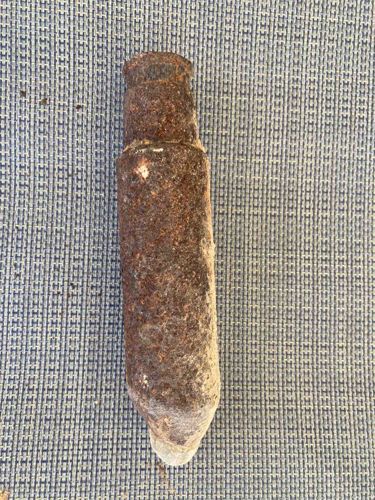
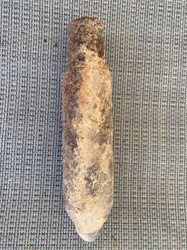
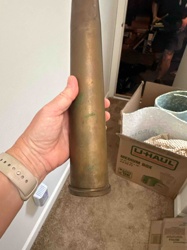
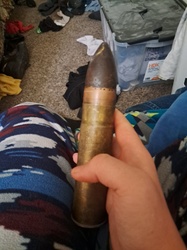
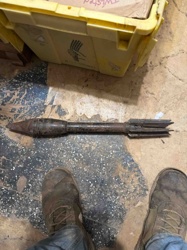
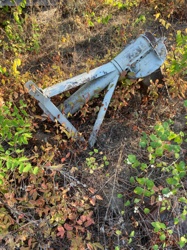
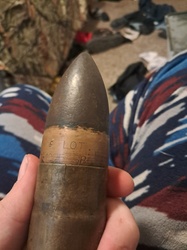
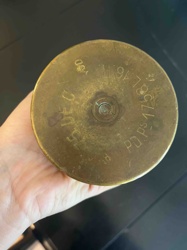
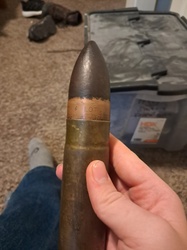
Found some type of artillery shell about 12” long weighs about 3 lbs
These notes were written by the person who submitted this item. Appraiser.AI has not verified them, and the AI's identification and estimate may rely on them.
AI Estimated Value
Not an official valuation
$20 - $50
AI estimate as of August 20, 2025 · verify with a professional before acting
AI-Generated · Verify before acting
Everything on this page is generated by AI for informational purposes only. AI can make mistakes — the AI may misidentify items or misattribute them (artist, maker, brand, designer, origin, era). This is not an official valuation and should not be used for insurance, sale, tax, estate, legal, or lending purposes — or any decision requiring a certified appraisal. It is not an authoritative claim about any person, brand, or rights holder — do not share or rely on it as a factual statement about a third party. Always consult qualified professionals before making financial decisions.
This analysis also relies on unverified notes provided by the user, which may be incomplete or inaccurate and could affect the result.
This appears to be a heavily corroded artillery projectile, likely made of iron or steel, given its significant rust and reported weight of 3 lbs. Its approximate length is 12 inches. The overall shape is cylindrical with a discernible tapering, conical nose at one end and a slightly narrower, possibly flat or recessed base at the other, typical of an unspent artillery shell or a solid shot projectile. The surface is completely covered in a thick, reddish-brown layer of severe oxidation, indicating prolonged exposure to moisture or burial in corrosive conditions. There are no clear markings, stamps, or distinguishing features visible due to the extensive rust and possible encrustations of soil or debris. The craftsmanship cannot be fully assessed due to the corrosion, but its original form suggests a robust, industrial manufacturing process. Based on its highly corroded state and the general design, it likely dates from an historical conflict, potentially late 19th or early 20th century warfare, when such projectiles were commonly used. The severe rust suggests it has been unearthed or recovered from a marine environment, leading to its current deteriorated condition. No repairs or significant damage other than the overall material degradation are visible.
AI Appraisal Report
I have examined the provided details and visual information concerning this artillery projectile. Based on its reported dimensions of 12 inches in length and 3 lbs in weight, along with the heavily corroded state, it appears to be a solid shot or unspent shell. The severe pitting and reddish-brown oxidation indicate prolonged exposure to harsh environmental conditions, likely burial or submersion. This degree of corrosion renders any original markings, manufacturer stamps, or identifying features completely obscured, making precise identification of its origin, type, or military service impossible from images alone. The item's cylindrical form with a tapering, conical nose and narrower base is consistent with historical artillery projectiles from the late 19th or early 20th century.
The condition severely limits its appeal to serious ordnance collectors who typically seek well-preserved examples with discernible features and provenance. The market for heavily corroded, unidentifiable ordnance is generally low, appealing mainly to novelty collectors or those interested in historical artifacts for display rather than academic study. Its authenticity as a genuine historical projectile seems plausible given its characteristics, but without clear markings or historical context, its exact nature (e.g., practice round, inert, or live) is undetermined, which is crucial for handling safety and legal considerations. For full authentication and to ascertain its original form, an in-person examination would be required to physically assess the material, search for any hidden features, and potentially conduct non-destructive testing like X-ray imaging. Provenance documentation, if available, would significantly enhance its value. Because of its condition and lack of identifying features, its rarity is difficult to assess; similar corroded items are not uncommon finds, but verifiable historical impact or unique design features would be needed to establish true rarity. The primary factors impacting value are the severe corrosion obscuring all details, the lack of positive identification, and the inherent safety concerns associated with unknown ordnance.