Victorian Era Carved Walnut Corner Whatnot Etagere
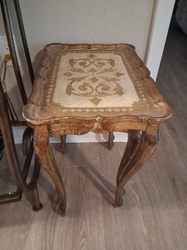
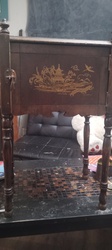
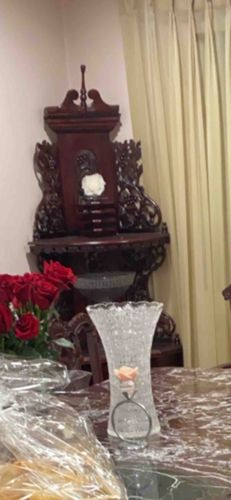
This is a multi-tiered Victorian-style corner whatnot or etagere, likely dating from the mid-to-late 19th century. The piece is constructed from a dark-stained hardwood, possibly walnut or rosewood, exhibiting a rich, deep mahogany-colored finish. A defining feature is the highly ornate pierced openwork carving that surrounds the central vertical support and flanks the shelving. The top section is crowned with a decorative pediment featuring scrolled 'swan neck' elements and a central turned finial. Below this, there appears to be a specialized display area, currently housing a small white floral or ceramic ornament. The shelves feature scalloped or dentil-carved edges, further emphasizing the ornate Gothic or Rococo Revival craftsmanship common in high-end 19th-century parlor furniture. The lower sections continue the theme of intricate fretwork supports. In terms of condition, the wood retains a high-gloss luster, though some minor dust accumulation is visible in the deep recesses of the carvings. The structural integrity appears sound from this perspective, with no immediately obvious losses to the delicate fretwork, though such pieces often possess small nicks or professional repairs tucked into the intricate patterns. The craftsmanship is of high quality, indicative of a master woodworker capable of precise hand-carving and detailed joinery.
AI-Generated Appraisal Disclaimer
Estimated Value
$1,200 - $1,800
Basic Information
Category
Antique Furniture
Appraised On
January 17, 2026
Estimated Value
$1,200 - $1,800
Item Description
This is a multi-tiered Victorian-style corner whatnot or etagere, likely dating from the mid-to-late 19th century. The piece is constructed from a dark-stained hardwood, possibly walnut or rosewood, exhibiting a rich, deep mahogany-colored finish. A defining feature is the highly ornate pierced openwork carving that surrounds the central vertical support and flanks the shelving. The top section is crowned with a decorative pediment featuring scrolled 'swan neck' elements and a central turned finial. Below this, there appears to be a specialized display area, currently housing a small white floral or ceramic ornament. The shelves feature scalloped or dentil-carved edges, further emphasizing the ornate Gothic or Rococo Revival craftsmanship common in high-end 19th-century parlor furniture. The lower sections continue the theme of intricate fretwork supports. In terms of condition, the wood retains a high-gloss luster, though some minor dust accumulation is visible in the deep recesses of the carvings. The structural integrity appears sound from this perspective, with no immediately obvious losses to the delicate fretwork, though such pieces often possess small nicks or professional repairs tucked into the intricate patterns. The craftsmanship is of high quality, indicative of a master woodworker capable of precise hand-carving and detailed joinery.
Get Your Items Appraised
Instant estimates of your treasures with AI-powered instant appraisals