AI estimate as of September 2, 2025 · verify with a professional before acting
AI-Generated · Verify before acting
Everything on this page is generated by AI for informational purposes only. AI can make mistakes — the AI may misidentify items or misattribute them (artist, maker, brand, designer, origin, era). This is not an official valuation and should not be used for insurance, sale, tax, estate, legal, or lending purposes — or any decision requiring a certified appraisal. It is not an authoritative claim about any person, brand, or rights holder — do not share or rely on it as a factual statement about a third party. Always consult qualified professionals before making financial decisions.
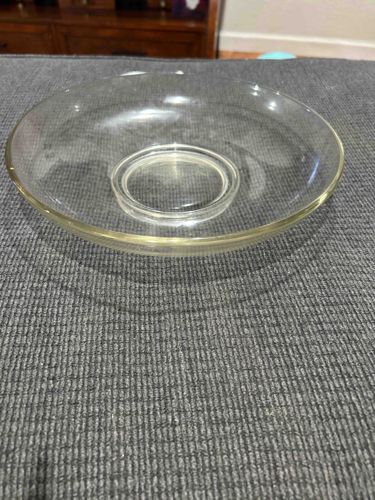
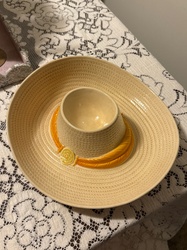
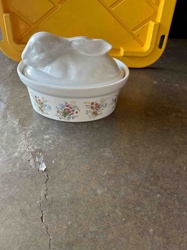
This item is a clear glass chip and dip serving bowl, designed with a central, raised circular indentation to hold a smaller bowl for dip, while the larger outer bowl holds chips or other snacks. The bowl appears to be made from clear, colorless glass, exhibiting good transparency with no visible tint or cloudiness. Its form is shallow and wide, typical of a serving platter. The rim of the main bowl is smooth and slightly rolled or fire-polished, indicating careful finishing. The raised central ring, which forms the dip holder, is also smoothly finished, suggesting a cohesive, single-piece construction rather than an assembly of separate components. There are no noticeable chips, cracks, or significant scratches visible on the surface, suggesting the item is in good to very good used condition. The glass retains its clarity and luster. There are no visible maker's marks, signatures, or embossed details, which is common for utilitarian glass serveware. Based on its design and material, it likely dates from the mid-20th century onwards, reflecting a functional and understated aesthetic typical of mass-produced consumer goods from that period. The craftsmanship appears to be standard for machine-pressed or molded glass, with a uniform thickness and smooth surfaces, indicative of practical and durable kitchenware.
AI Appraisal Report
Based on my visual examination of the provided image, this clear glass chip and dip serving bowl appears to be in good to very good used condition. I see good transparency with no visible tint or cloudiness, and no obvious chips, cracks, or significant scratches. The smooth finish on both the main rim and the central dip holder suggests a well-made, possibly single-piece construction, typical of mid-20th century to contemporary utilitarian glass. Its authenticity as a mass-produced serveware item is highly likely given its design. However, without a physical inspection, I cannot rule out very fine surface scratches, subtle manufacturing flaws, or restorations that might not be visible in the image.
From a market perspective, clear glass chip and dip sets are quite common. Comparable items, new or vintage, are widely available in various retail channels, including online marketplaces and second-hand shops, typically fetching modest prices. There is no indication of a specific maker's mark or unique design that would denote rarity or high demand among collectors. This type of item appeals to those seeking practical and functional kitchenware rather than decorative or antique value. Therefore, demand is generally stable but not exceptional.
The primary factors impacting value here are its commonality, lack of identifying marks, and utilitarian nature. While its condition appears excellent, the sheer volume of similar items in circulation keeps the value relatively low. For full authentication, especially if there were an assertion of a specific manufacturer or age beyond what's visually apparent, an in-person examination would be crucial to inspect for subtle mold lines, pontil marks (though unlikely for this type), or manufacturing characteristics. Provenance documentation could also support claims of origin, but for this item, it's generally not necessary. Scientific testing is typically reserved for more high-value, rare items and would be excessive here.