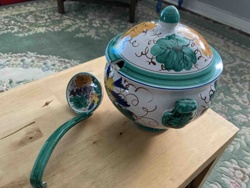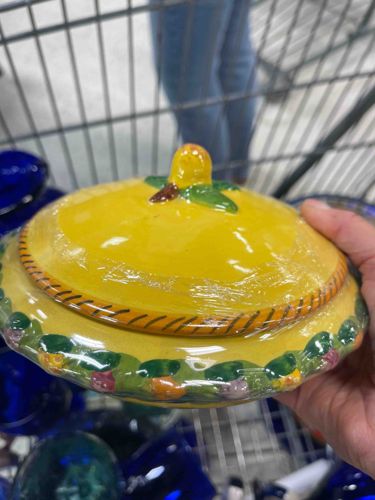
Vintage Italian Hand-Painted Majolica Fruit Motif Lidded Bowl (Potential Tortilla Warmer or Casserole Dish)
Vintage Ceramic Kitchenware

Vintage Italian Hand-Painted Majolica Fruit Motif Lidded Bowl (Potential Tortilla Warmer or Casserole Dish)

This is a hand-painted ceramic lidded serving dish, likely mid-to-late 20th-century Italian Majolica or a similar Mediterranean earthenware. The piece features a vibrant yellow glaze on the low-domed lid and outer base, accented by a decorative green leaf and colorful fruit border along the flared rim. The lid is crowned with a three-dimensional figural lemon finial accompanied by green leaves and a brown stem. Notable construction details include a 'rope-twist' or braided texture painted in orange and brown tones along the inner lip of the lid. The glaze exhibits a high-gloss finish, though it is currently obscured by protective plastic wrap. While maker's marks are not visible through the wrap, the style suggests a production origin from the Deruta or Bassano regions of Italy, common in mid-century kitchen imports. The condition appears fair to good; there is some visible glaze crazing and minor chips along the edges of the fruit border, characteristic of soft-paste earthenware. The hand-painted application shows typical variations in pigment density, indicating artisan production rather than industrial mass-printing.
Estimated Value

$45.00 - $75.00

Basic Information

Category

Vintage Ceramic Kitchenware

Appraised On

March 10, 2026

Estimated Value

$45.00 - $75.00

Item Description

This is a hand-painted ceramic lidded serving dish, likely mid-to-late 20th-century Italian Majolica or a similar Mediterranean earthenware. The piece features a vibrant yellow glaze on the low-domed lid and outer base, accented by a decorative green leaf and colorful fruit border along the flared rim. The lid is crowned with a three-dimensional figural lemon finial accompanied by green leaves and a brown stem. Notable construction details include a 'rope-twist' or braided texture painted in orange and brown tones along the inner lip of the lid. The glaze exhibits a high-gloss finish, though it is currently obscured by protective plastic wrap. While maker's marks are not visible through the wrap, the style suggests a production origin from the Deruta or Bassano regions of Italy, common in mid-century kitchen imports. The condition appears fair to good; there is some visible glaze crazing and minor chips along the edges of the fruit border, characteristic of soft-paste earthenware. The hand-painted application shows typical variations in pigment density, indicating artisan production rather than industrial mass-printing.
Get Your Items Appraised

Instant estimates of your treasures with AI-powered instant appraisals

Browse More Appraisals