Australian Aboriginal Bark Painting
Indigenous Australian/Tribal Art

Australian Aboriginal Bark Painting

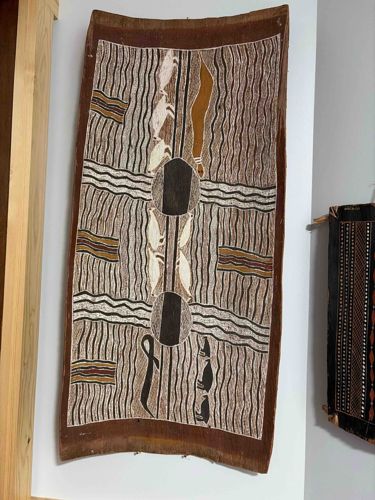
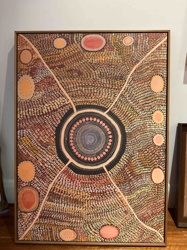
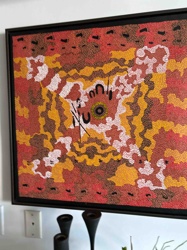
This is a significant piece of Aboriginal Australian art, specifically a bark painting, likely originating from the Arnhem Land region of the Northern Territory. The piece is created on a rectangular sheet of eucalyptus bark, which has been flattened and cured. The surface is decorated using a traditional palette of natural earth pigments (ochres) in shades of white, red, yellow, and black. The composition features a central vertical axis connecting two dark circular forms, surrounded by fine cross-hatching known as rarrk, which indicates clan or regional identity. Native fauna, possibly fish or mammals, are depicted in a stylized white silhouette along the center and edges, alongside darker figures that may represent spirit beings or ancestors. The background is densely filled with wavy lines and geometric patterns reflecting a Dreamtime narrative. Physically, the bark exhibits a natural slight curve and rough, unrefined edges characteristic of the medium. There is visible wear consistent with mid-to-late 20th-century production, including minor pigment loss and fraying at the fibrous edges of the bark. The craftsmanship demonstrates a high level of skill in rarrk application, creating a sense of shimmering light or movement known as bir'yun.
Estimated Value

$4,500 - $6,500

Basic Information

Category

Indigenous Australian/Tribal Art

Appraised On

January 2, 2026

Estimated Value

$4,500 - $6,500

Item Description

This is a significant piece of Aboriginal Australian art, specifically a bark painting, likely originating from the Arnhem Land region of the Northern Territory. The piece is created on a rectangular sheet of eucalyptus bark, which has been flattened and cured. The surface is decorated using a traditional palette of natural earth pigments (ochres) in shades of white, red, yellow, and black. The composition features a central vertical axis connecting two dark circular forms, surrounded by fine cross-hatching known as rarrk, which indicates clan or regional identity. Native fauna, possibly fish or mammals, are depicted in a stylized white silhouette along the center and edges, alongside darker figures that may represent spirit beings or ancestors. The background is densely filled with wavy lines and geometric patterns reflecting a Dreamtime narrative. Physically, the bark exhibits a natural slight curve and rough, unrefined edges characteristic of the medium. There is visible wear consistent with mid-to-late 20th-century production, including minor pigment loss and fraying at the fibrous edges of the bark. The craftsmanship demonstrates a high level of skill in rarrk application, creating a sense of shimmering light or movement known as bir'yun.
Get Your Items Appraised

Instant estimates of your treasures with AI-powered instant appraisals

Browse More Appraisals