AI estimate as of August 6, 2025 · verify with a professional before acting
AI-Generated · Verify before acting
Everything on this page is generated by AI for informational purposes only. AI can make mistakes — the AI may misidentify items or misattribute them (artist, maker, brand, designer, origin, era). This is not an official valuation and should not be used for insurance, sale, tax, estate, legal, or lending purposes — or any decision requiring a certified appraisal. It is not an authoritative claim about any person, brand, or rights holder — do not share or rely on it as a factual statement about a third party. Always consult qualified professionals before making financial decisions.
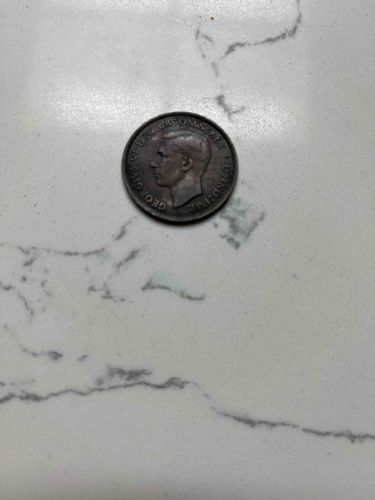
The item is a circular metal coin, appearing to be made of a bronze or copper alloy, judging by its dark, somewhat reddish-brown coloration and the visible patina. The obverse side is depicted, featuring a meticulously rendered profile bust of a male figure facing left, consistent with an effigy of a monarch. The detail level of the facial features, hair, and neck is fair, indicating some wear but still clearly discernible. Surrounding the bust, along the rim, there is an inscription in Latin script. Portions of the inscription are legible, notably 'GEORGIVS VI' (George VI) on the left side and 'D:G:BR:OMN:REX F:D:IND:IMP' (By the Grace of God, King of all the Britains, Defender of the Faith, Emperor of India) visible on the upper and right sides. This inscription clearly identifies the monarch as King George VI, placing the coin's mintage between 1936 and 1947 (when 'IND:IMP' was removed). The coin exhibits significant signs of wear consistent with circulation, including a dull, uneven surface luster rather than a bright, reflective finish. There are no obvious deep scratches, dents, or signs of deliberate damage, but the high points of the design, particularly around the effigy's hair and clothing, show flattening from continuous handling. The rim also displays some smoothing and minor nicks. The overall size appears to be standard for a circulating coin of the mid-20th century, likely a penny or half-penny from the United Kingdom or one of its Commonwealth nations. The craftsmanship is typical of government-issued coinage, focusing on clarity of design and durability for circulation. The patina suggests natural aging, adding to its historical character.
AI Appraisal Report
I have carefully examined the provided image of this King George VI coin (Obverse). Based on the visible details, I assess its condition as 'Good' (G) to 'Very Good' (VG) on the Sheldon scale, primarily due to the significant, yet even, wear. The inscription 'GEORGIVS VI D:G:BR:OMN:REX F:D:IND:IMP' is clearly legible, confirming its identity and dating it between 1937 and 1948 (prior to the removal of 'IND:IMP'). The overall appearance, including the characteristic patina of bronze or copper, is consistent with authentic coinage from this period.
Market conditions for common King George VI circulating coins are generally stable, with significant supply. This coin, likely a penny or half-penny given its description, is not rare. Millions were minted. The primary factors impacting its value are its commonality, relatively low grade, and lack of unique distinguishing features (like a key date or mint mark for varieties). There is consistent, albeit low, demand from new collectors or those filling date sets, but seasoned collectors typically seek higher-grade examples.
Factors that significantly impact its value downwards include the dull surface, flattened high points of the effigy, and general signs of heavy circulation. Without physical examination, I cannot definitively confirm the absence of subtle damage (e.g., hairlines not visible in the image) or precisely gauge the luster. For full authentication and a more precise grade, I would require in-person examination to inspect edge details, weight, diameter, and strike quality, and to confirm the metallic composition. Provenance documentation would add to its history, but for common coins, it rarely impacts value significantly.