AI identification & appraisal estimate

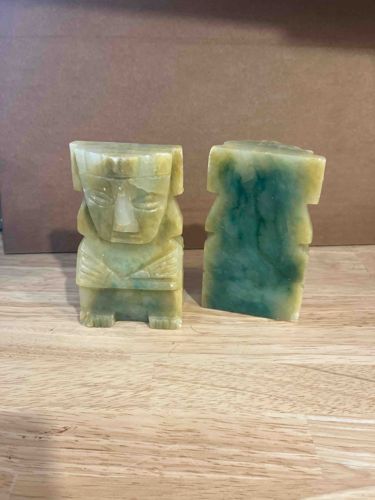
Pair of Mesoamerican-Style Green Stone Figurines

This name is the AI's identification of the item — it may be incorrect.

Submitted photo of Pair of Mesoamerican-Style Green Stone Figurines
Photo submitted by the user — not generated by AI

User's notes

Mid century

These notes were written by the person who submitted this item. Appraiser.AI has not verified them, and the AI's identification and estimate may rely on them.

AI Estimated Value

Not an official valuation

$200-350

AI estimate as of July 9, 2025 · verify with a professional before acting

AI-Generated · Verify before acting

Everything on this page is generated by AI for informational purposes only. AI can make mistakes — the AI may misidentify items or misattribute them (artist, maker, brand, designer, origin, era). This is not an official valuation and should not be used for insurance, sale, tax, estate, legal, or lending purposes — or any decision requiring a certified appraisal. It is not an authoritative claim about any person, brand, or rights holder — do not share or rely on it as a factual statement about a third party. Always consult qualified professionals before making financial decisions.

This analysis also relies on unverified notes provided by the user, which may be incomplete or inaccurate and could affect the result.

Read the full disclaimer

AI Item Analysis

The image displays a pair of carved stone figurines, likely crafted from jade or a similar nephrite/serpentine material, exhibiting a distinctive greenish-yellow hue with darker green striations and cloudy inclusions indicative of natural stone. The item on the left is a figural representation, possibly depicting an Aztec or Mayan deity or ancestral figure, characterized by a stylized human face with prominent forehead, recessed eyes, and a triangular nose. Below the head, the body is simplified to a block-like form, with incised lines suggesting folded arms or stylized garments across the chest and a base resembling stylized feet. The carving style is somewhat linear and angular, characteristic of pre-Columbian Mesoamerican art or modern interpretations thereof. The surface appears polished, but natural variations and minor surface irregularities are visible. The item on the right is a more abstract, block-like form, possibly an unfinished carving or a companion piece, also exhibiting the same natural stone color variations. Its silhouette suggests a similar head-and-body structure to the figural piece, but without the detailed facial features. Given the 'Mid century' context, these pieces could be mid-20th-century reproductions or inspired by ancient Mesoamerican art, often popular during that period. There are no immediately obvious signs of damage like chips or cracks, but the natural variations in the stone and inherent carving lines define its overall condition. The craftsmanship appears competent, utilizing the natural material's aesthetic properties. The quality is indicative of decorative art pieces rather than archaeological artifacts.

AI Appraisal Report

Upon examining the images of this pair of Mesoamerican-style green stone figurines, several key characteristics inform my valuation. The items are presented as 'Mid-century' pieces, and their stylistic execution aligns with the popular interest in Pre-Columbian art during that era. The material appears to be a type of green stone, possibly serpentine or a lower-grade jadeite, exhibiting attractive natural variations in color. The craftsmanship of the primary figure is competent, capturing the stylized, angular aesthetic of ancient Mesoamerican carvings, though it lacks the fine detail and specific iconography of a genuine archaeological artifact. The second, more abstract piece serves as a complementary decorative object. The market for such mid-century decorative artworks is steady, appealing to collectors of that period's design ethos. Comparable sets of stylized stone carvings from the mid-20th century, often sold as tourist or decorative art, typically trade in the low to mid-hundreds. The value is driven by their decorative appeal rather than any historical or archaeological significance. Their condition appears to be good from the images, with no obvious chips or cracks. It is crucial to note that this appraisal is based solely on visual examination of images and assumes the pieces are mid-century decorative objects. A definitive authentication distinguishing them from modern reproductions or, conversely, genuine ancient artifacts would require physical inspection. This would involve a materials analysis (e.g., gemological testing), tool mark examination under magnification, and a review of any provenance documentation to trace their history. Without such rigorous verification, they are valued as decorative art.

Keep exploring

More sculpture/figurine appraisals

Get your items appraised

Instant AI-powered appraisal estimates from a photo

Browse More Appraisals