AI estimate as of July 19, 2025 · verify with a professional before acting
AI-Generated · Verify before acting
Everything on this page is generated by AI for informational purposes only. AI can make mistakes — the AI may misidentify items or misattribute them (artist, maker, brand, designer, origin, era). This is not an official valuation and should not be used for insurance, sale, tax, estate, legal, or lending purposes — or any decision requiring a certified appraisal. It is not an authoritative claim about any person, brand, or rights holder — do not share or rely on it as a factual statement about a third party. Always consult qualified professionals before making financial decisions.
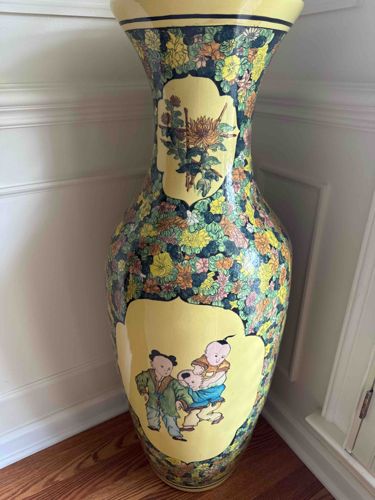
This is a large, floor-standing porcelain vase with a vibrant, multicolored enamel decoration. Its physical characteristics include a flaring rim, a long, slender neck that tapers inward, a broad shoulder, and a gradually widening body that narrows slightly towards the base. The overall shape suggests a classic oriental vase form often referred to as a 'baluster' or 'guanyin' shape. The dominant colors in the decoration are a rich, dark background (possibly dark green or black) heavily overlaid with a profusion of colorful floral motifs, likely chrysanthemums and other blossoms, rendered in yellow, orange, blue, green, and pink hues. Interrupting the busy floral pattern are two large, distinct cartouches with a light yellow ground. The upper cartouche depicts a detailed botanical scene, specifically a large, orange chrysanthemum in bloom with green foliage, possibly indicative of scholarly pursuits or autumnal themes. The lower cartouche features a figural scene with three young children or 'boys' engaged in playful activities, a common motif in Chinese porcelain symbolizing good fortune, progeny, and happiness. This 'hundred boys' motif is often associated with the Qing Dynasty, particularly the Republic period or later interpretations of traditional designs. The craftsmanship appears to be hand-painted given the slight variations and expressive brushwork visible. There are no obvious signs of significant damage such as chips, cracks, or repairs, and the enamels appear to retain their original luster, suggesting good preservation. The age is estimated to be late 19th to mid-20th century, likely produced for export, although without a visible maker's mark or signature, a more precise dating is challenging. The substantial size and intricate detailing indicate a piece of decorative quality, likely intended as a statement piece in an interior.
AI Appraisal Report
I have examined the provided image of this Large Polychrome Enamel Chinese Porcelain Floor Vase. Physically, the vase presents a classic baluster form, indicative of traditional Chinese porcelain. The vibrant polychrome enamel decoration, featuring a dark ground heavily overlaid with floral motifs and distinct cartouches, is a testament to decorative artistry. One cartouche showcases a botanical scene, while the other features the auspicious 'hundred boys' motif, common in later Qing and Republic period porcelain. The condition appears to be very good; I observe no obvious chips, cracks, or repairs, and the enamels retain good luster. This suggests careful preservation over its lifespan.
Authenticity, based on visual assessment alone, points towards a late 19th to mid-20th century production. The style and motifs align with that period, often produced for export. Craftsmanship appears hand-painted, which adds to its decorative appeal.
In terms of market conditions, large-scale decorative Chinese porcelain, especially pieces in good condition with appealing motifs like the 'hundred boys', generally hold steady demand. Comparable sales for similar baluster-form vases of this period, size, and decorative quality, particularly those without specific imperial attribution or well-documented provenance, typically fall within a modest to moderate range. Rarity is limited as such pieces were produced in some quantity, but good condition examples are less common.
Factors impacting value include its substantial size, intricate decoration, and apparent excellent condition. However, the lack of a visible maker's mark or specific imperial attribution, and the general decorative nature rather than fine art status, temper the value.
Limitations in authenticity verification are significant. Without physical examination, I cannot confirm the exact porcelain body type, feel the quality of the glaze, or thoroughly inspect for invisible repairs or structural integrity. A physical examination would allow for closer inspection of painting quality, enamel thickness, and any base marks. Provenance documentation, if available, would significantly aid in precise dating and attribution. Scientific testing of the materials could further confirm age and composition.