These notes were written by the person who submitted this item. Appraiser.AI has not verified them, and the AI's identification and estimate may rely on them.
AI Estimated Value
Not an official valuation
$1,800 - $2,800
AI estimate as of December 5, 2025 · verify with a professional before acting
AI-Generated · Verify before acting
Everything on this page is generated by AI for informational purposes only. AI can make mistakes — the AI may misidentify items or misattribute them (artist, maker, brand, designer, origin, era). This is not an official valuation and should not be used for insurance, sale, tax, estate, legal, or lending purposes — or any decision requiring a certified appraisal. It is not an authoritative claim about any person, brand, or rights holder — do not share or rely on it as a factual statement about a third party. Always consult qualified professionals before making financial decisions.
This analysis also relies on unverified notes provided by the user, which may be incomplete or inaccurate and could affect the result.
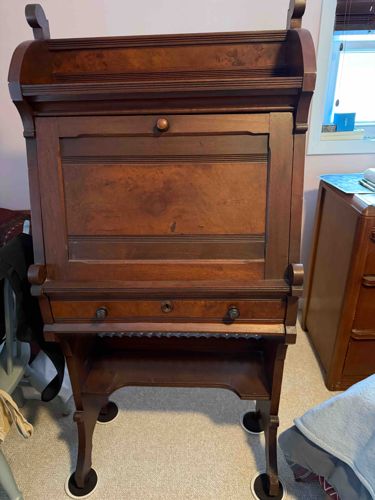
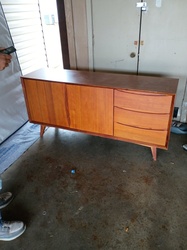
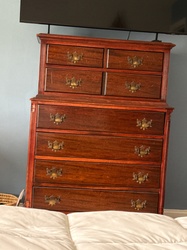
This is a freestanding cherry wood drop-front secretary desk, also known as a fall-front writing desk, estimated to be from the 1830-1850 era. The desk features a rich, dark cherry finish, exhibiting varied grain patterns, particularly prominent on the drop-front panel where some burl or mottled figure is visible. The overall construction appears solid and well-crafted, indicative of period furniture.
Physically, it is a tall, narrow piece of furniture. The upper section features a rounded, perhaps roll-top-style, molding or cresting at the top, flanked by two small, carved finials that extend above the main body. Below this, a large, rectangular drop-front panel constitutes the primary writing surface when opened. This panel is framed by raised molding and features a small, possibly brass or wooden, knob for opening. A few faint marks or scuffs are visible on this panel, consistent with age and use.
Below the drop-front, there is a single drawer with two small, turned wooden knobs and a keyhole, suggesting it might be lockable. Beneath this drawer, a decorative, scalloped or pierced apron provides an aesthetic touch. The desk is supported by four elegantly turned or carved legs, which appear to extend downward, terminating in what look like modern furniture glides or coasters, suggesting it has been moved or protected. A lower shelf is integrated between the legs, offering additional storage or display space.
Observable condition issues include some general wear and tear, minor scratches, and abrasions consistent with its age. Some areas show a slightly lighter patina where the finish may have worn thin. There are no obvious signs of major structural damage or repairs, though a detailed inspection would be required to confirm. The craftsmanship suggests a piece made with attention to detail, utilizing joinery techniques common to the early to mid-19th century. The dark wood and classical design elements align well with the Biedermeier or early Victorian styles prevalent during its estimated period.
AI Appraisal Report
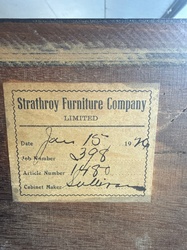
Based on my visual examination of the provided image and the owner's details, this Cherry Wood Drop-Front Secretary Desk appears to be a well-preserved example from the 1830-1850 era, consistent with its Biedermeier or early Victorian styling. The rich dark cherry finish, varied grain, and visible burl on the drop-front add significantly to its aesthetic appeal. The overall construction quality, including the carved finials, turned legs, and decorative apron, indicates good craftsmanship for the period. Condition-wise, the desk shows expected wear and tear, including minor scratches and abrasions, and some finish thinning, which are all commensurate with its age and typical use. There are no obvious signs of major structural damage or amateur repairs, which is a positive factor.
Market conditions for well-maintained period American or European furniture of this style remain steady, particularly for functional pieces like secretary desks. Comparables in good, original condition, exhibiting similar age and quality, often fetch prices in the range I've provided. Demand for such pieces is driven by collectors and individuals seeking authentic antique furniture. Rarity is moderate; while secretary desks are not exceedingly rare, one in this condition with attractive wood and detailing from this specific period is desirable.
Factors significantly impacting value include its good original condition, attractive wood, and functional design. The presence of what appear to be modern furniture glides/coasters is a minor detractor but easily reversible. My primary limitation in this appraisal is the lack of physical inspection. Full authentication would require an in-person examination to assess joinery, wood species, and internal wear more thoroughly. Scientific testing could verify wood age and finish composition, and provenance documentation (e.g., family history or prior sales records) would further solidify its authenticity and history, potentially increasing its upper value.