AI Appraisal Estimate

AI-generated estimates · not official valuations

From the user

What was submitted

Photo and notes provided by the user — not generated by AI

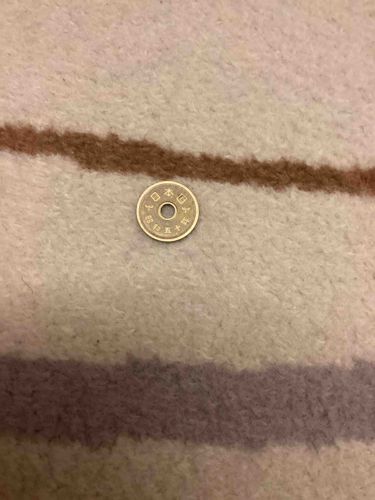
Submitted item photo
Submitted photo · May 27, 2026

User's notes

No additional notes provided.

AI analysis below

AI appraisal

AI analysis & estimate

AI-Generated · Verify before acting

Everything below is generated by AI for informational purposes only. AI can make mistakes — the AI may misidentify items or misattribute them (artist, maker, brand, designer, origin, era). This is not an official valuation and should not be used for insurance, sale, tax, estate, legal, or lending purposes — or any decision requiring a certified appraisal. It is not an authoritative claim about any person, brand, or rights holder — do not share or rely on it as a factual statement about a third party. Always consult qualified professionals before making financial decisions.

Read the full disclaimer

AI Identification

·Not independently authenticated·Verify before acting

Japanese 5 Yen Coin (Go-en)

Numismatics / Currency

AI Estimated Value

·Not an official valuation·Verify before acting

$0.04 - $0.25

As of May 27, 2026

AI Item Analysis

·AI can make mistakes·Verify before acting
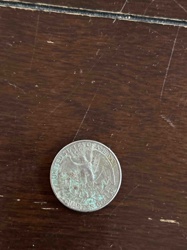
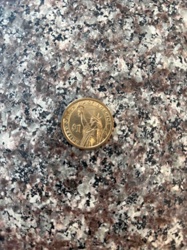
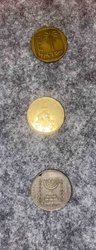
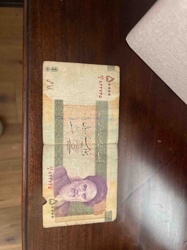
This item is a standard Japanese 5 yen circulation coin, characterized by its distinctive golden-brass color and central hole. The coin is composed of a brass alloy typically consisting of 60% to 70% copper and 30% to 40% zinc. It features a diameter of 22mm and a thickness of 1.5mm, with a central hole measuring 5mm, which was originally included to save metal in post-war production. The obverse side (appearing face-up) displays Kanji characters indicating state origin and the era of minting. Specifically, the text 'Nihon-koku' (State of Japan) is written at the top, and 'Showa Goju-nen' (Year 50 of the Showa era) is written at the bottom, dating the piece to 1975. The design traditionally incorporates agricultural and industrial motifs: an ear of rice around the hole representing agriculture, horizontal lines representing water (fisheries), and a gear around the hole representing industry. The condition appears to be 'circulated,' showing typical surface wear, light scratches, and a duller patina consistent with use in commerce rather than a mint-state collection. No significant deformations, deep gouges, or edge nicks are visible from the image, suggesting average preservation for its age. The 5 yen coin is culturally significant in Japan, as the word 'go-en' is a homophone for a word meaning 'good fortune' or 'karmic connection,' making it a frequent choice for shrine offerings.
AI Appraisal Report

·AI can make mistakes·Verify before acting
Based on my visual examination of the provided descriptions and visuals for this 1975 (Showa 50) Japanese 5 Yen coin, I have determined it to be a common circulation strike. The coin displays the characteristic brass composition and the 'kaiki' (central hole) design. My assessment of the condition is 'Circulated' (likely Fine to Very Fine grade). It exhibits the expected loss of original mint luster, replaced by a moderate patina and minor surface abrasions consistent with nearly 50 years of commercial use. I see no evidence of the 'fude-go' (brush script) variety, which ended in 1958, nor any obvious minting errors that would command a premium. From a market perspective, this is a high-mintage year with hundreds of millions produced; therefore, it lacks numismatic rarity. While its face value is 5 JPY (approx. $0.03-$0.04 USD), it may sell for up to $0.25 in Western novelty markets or as a 'good luck' charm due to its cultural 'Go-en' symbolism. Limitations: My appraisal is based on digital representation. To provide a definitive authentication, I would need to perform an in-person weight verification (standard 3.75g) and diameter check (22mm) to rule out contemporary counterfeits. Microscopic inspection would be required to verify the absence of 'tooling' or cleaning marks that could devalue the piece even further. Documentation of its source or inclusion in a certified mint set would bolster its provenance, but for a standard circulation coin of this era, the cost of professional grading (e.g., PCGS or NGC) would significantly exceed the coin's market value.

Get your items appraised

Instant estimates of your treasures with AI-powered appraisals

Browse More Appraisals