AI estimate as of November 10, 2025 · verify with a professional before acting
AI-Generated · Verify before acting
Everything on this page is generated by AI for informational purposes only. AI can make mistakes — the AI may misidentify items or misattribute them (artist, maker, brand, designer, origin, era). This is not an official valuation and should not be used for insurance, sale, tax, estate, legal, or lending purposes — or any decision requiring a certified appraisal. It is not an authoritative claim about any person, brand, or rights holder — do not share or rely on it as a factual statement about a third party. Always consult qualified professionals before making financial decisions.
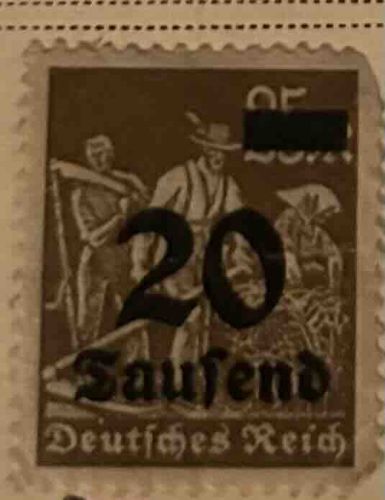
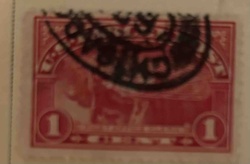
This item is a vintage German postal stamp, likely from the hyperinflation period of the early 1920s. The stamp is predominantly brown or sepia-toned, featuring a central vignette depicting a scene of agricultural or manual laborers. I can discern three figures: one on the left appears to be carrying tools or materials over a shoulder, a central figure wearing a hat with a feather and holding something akin to a pitchfork or scythe, and a third figure on the right, possibly a woman, engaged in work. The artistic style of the figures suggests a realistic or illustrative approach common in that era. Prominently displayed on the stamp are the numbers '20' in a large, bold font, and the German word 'Tausend' (meaning 'Thousand') directly below it, indicating a face value of 'Twenty Thousand'. Below 'Tausend', the words 'Deutsches Reich' (meaning 'German Empire' or 'German Realm') are visible in a traditional German script, confirming its origin. The stamp has perforated edges, characteristic of most postal stamps, which appear to be mostly intact, though the image quality makes it difficult to assess minor imperfections there. There is a partial black overprint in the upper right corner, obscuring some text or a numeral, but a '2' or similar character might still be faintly visible above it. This overprint might indicate a revaluation of the stamp's denomination, a common practice during periods of rapid inflation. The stamp's condition appears relatively good despite its age, with no apparent major tears or heavily creased areas, though some slight discoloration or paper aging is to be expected. The detailed illustration and clear typography suggest a high standard of printing for its time. This stamp serves as a tangible historical artifact documenting Germany's economic struggles in the post-World War I era.
AI Appraisal Report
I have carefully examined the provided image of the German Hyperinflation Stamp, "20 Tausend" from the early 1920s. Based on my visual inspection, the stamp appears to be a genuine issue from the German hyperinflationary period, specifically from the "Workers" or "Pflug" (Ploughman) series. The design, including the depiction of laborers, the prominent "20 Tausend" denomination, and "Deutsches Reich" inscription, is consistent with known examples of these issues.
The condition, as far as can be determined from an image, appears to be relatively good for its age. The perforations seem largely intact, and there are no immediately obvious major tears or creases, though some natural toning or slight discoloration is present, which is common. The partial black overprint is interesting; these stamps were frequently surcharged due to the rapidly changing currency values. An in-person examination would be crucial to assess the exact nature and authenticity of this overprint, as well as to detect any minor imperfections like thins, repairs, or expertizing marks that are invisible in the image.
Regarding market conditions, these hyperinflation issues, while historically significant, are generally not rare. Millions were printed. Demand is steady among collectors of German philately and historical documents, but these specific issues are quite common. The value is largely driven by condition, centering, and the presence of any rare overprints or cancellations. Individually, common examples, even in good condition, typically fetch modest prices. Without physical inspection to verify the overprint's authenticity and to fully assess the stamp's condition (including gum, paper integrity, latent repairs, faults hidden by the image resolution), a definitive high value cannot be assigned.
For full authentication and a more precise valuation, I would require a physical examination to check for watermarks, paper type, gum condition, micro-perforations, and the specifics of the overprint. Provenance, if available (e.g., from a reputable collection), would also add to its verifiable authenticity. Scientific testing, such as UV light analysis, could further confirm paper and ink authenticity.
Given the common nature of this specific stamp series and assuming a typical, sound but unexceptional condition as suggested by the image, I estimate the appraisal value to be between $5 and $15.