AI estimate as of November 8, 2025 · verify with a professional before acting
AI-Generated · Verify before acting
Everything on this page is generated by AI for informational purposes only. AI can make mistakes — the AI may misidentify items or misattribute them (artist, maker, brand, designer, origin, era). This is not an official valuation and should not be used for insurance, sale, tax, estate, legal, or lending purposes — or any decision requiring a certified appraisal. It is not an authoritative claim about any person, brand, or rights holder — do not share or rely on it as a factual statement about a third party. Always consult qualified professionals before making financial decisions.
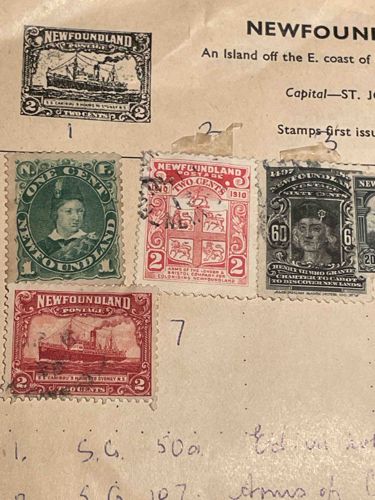
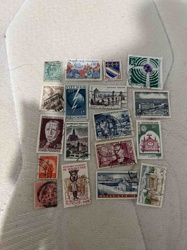
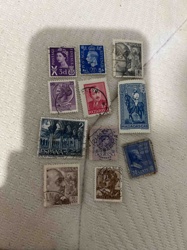
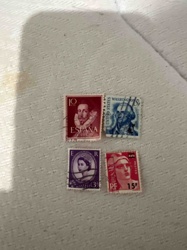
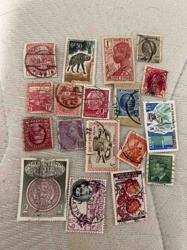
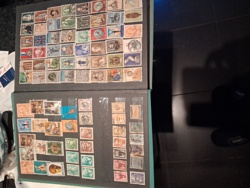
This item is a collection of Newfoundland postage stamps, likely mounted on pages from a stamp album. The visible stamps include several distinct designs and denominations, indicative of various issues from Newfoundland's postal history. One prominent stamp, in black ink, depicts a steamship under sail and steam, with the denomination 'TWO CENTS' and 'NEWFOUNDLAND' clearly visible at the top, numbered '1' below it. Another stamp, in a green hue, features a portrait of a female figure, possibly Queen Victoria or a historical effigy, with 'ONE CENT' and 'NEWFOUNDLAND' inscribed, displaying classic Victorian-era design elements. A red stamp, possibly commemorating 1910, exhibits a coat of arms with lions and a cross, marked 'NEWFOUNDLAND TWO CENTS'. Another red stamp, similar in design to the black steamship stamp but in a different color and possibly a different issue, also shows a steamship and 'NEWFOUNDLAND POSTAGE' with '2 Cents'. A grey-toned stamp shows a male portrait with '1497 NEWFOUNDLAND SIXTY CENTS' and 'HENRY VII WHO GRANTED CHARTER TO CABOT TO DISCOVER NEW LANDS', suggesting a commemorative issue related to John Cabot's discovery. The stamps exhibit perforations around their edges, a standard feature of postage stamps. Some stamps appear to be affixed with hinges, as evidenced by visible hinge marks (e.g., above the red coat of arms stamp). The paper of the album page is aged, with some yellowing and handwritten annotations in ink and pencil, such as '1. S.G. 50a' and '7', which likely refer to Scott Catalogue (S.G.) numbers or other philatelic indexing. The overall condition shows signs of age and handling, consistent with a vintage collection. The presence of multiple denominations, designs, and potential commemorative issues suggests a curated collection representing different periods of Newfoundland's postal history before its confederation with Canada.
AI Appraisal Report
I have examined the provided image of this Newfoundland postage stamp collection, which appears to be mounted on album pages. Based on the visual evidence, the collection includes a variety of Newfoundland issues, highlighting different postal periods. Key examples include the black steamship 'TWO CENTS' stamp, a green 'ONE CENT' featuring a portrait (likely Queen Victoria), a red coat of arms stamp (possibly 1910 issue), and a grey 'SIXTY CENTS' depicting 'HENRY VII' commemorating Cabot. The stamps generally exhibit perforations, and some show evidence of hinge marks, suggesting they are previously mounted. The album page itself shows age-related yellowing and handwritten annotations, consistent with a vintage collection.
Authenticity: While the designs appear consistent with known Newfoundland issues, definitive authentication of the stamps' originality, gum condition, and absence of repairs or alterations cannot be made from images alone. An in-person examination would be crucial to verify watermarks, paper types, printing methods, and gum status. Similarly, the 'S.G. 50a' annotation suggests catalog references, but I would need to confirm the specific stamps against a philatelic catalog to verify their exact identification and potential varieties.
Condition: The observable condition of the stamps appears to be fair to good, with some signs of aging common for such vintage items. The presence of hinges, while common in older collections, can affect value for mint issues. Without physical inspection, I cannot assess toning, fading, or minor imperfections that might be present.
Market Conditions and Comparables: Newfoundland stamps are generally popular among British North America collectors. The inclusion of various denominations and commemorative issues adds to the collection's appeal. Rarity varies significantly by stamp issue, condition, and specific varieties. Without precise catalog identification for each stamp, I am relying on the general presence of diverse issues to inform value.
Demand: Demand for Newfoundland stamps remains stable among specialized collectors. Collections of this nature, offering a historical overview, typically attract interest.
Factors Impacting Value: The primary factors impacting value here are the actual catalog values of the identified stamps, their individual condition (which I cannot definitively assess from images), and the completeness or curated nature of the collection beyond what is visible. The potential for rare varieties or better-than-apparent condition could increase the value. Conversely, hidden faults or common issues could decrease it.
Limitations: My appraisal is limited by the visual nature of the examination. Physical inspection is essential for definitive authentication, precise condition assessment, and accurate cataloging of each stamp. An in-person review would allow for examination of gum, watermarks, paper, and any repairs, which significantly impact value. Provenance documentation, if available, would also add to the certainty of value.