AI identification & appraisal estimate

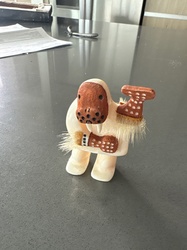
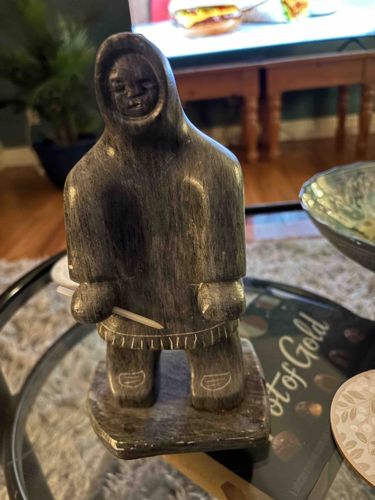
Inuit Stone Carving by Dimu (Dimu Arctic Handcrafts)

Submitted photo of Inuit Stone Carving by Dimu (Dimu Arctic Handcrafts)
Photo submitted by the user — not generated by AI

User's notes

Has the name Dimu and a symbol

These notes were written by the person who submitted this item. Appraiser.AI has not verified them, and the AI's identification and estimate may rely on them.

AI Estimated Value

Not an official valuation

$150 - $250

AI estimate as of January 18, 2026 · verify with a professional before acting

AI-Generated · Verify before acting

Everything on this page is generated by AI for informational purposes only. AI can make mistakes — the AI may misidentify items or misattribute them (artist, maker, brand, designer, origin, era). This is not an official valuation and should not be used for insurance, sale, tax, estate, legal, or lending purposes — or any decision requiring a certified appraisal. It is not an authoritative claim about any person, brand, or rights holder — do not share or rely on it as a factual statement about a third party. Always consult qualified professionals before making financial decisions.

This analysis also relies on unverified notes provided by the user, which may be incomplete or inaccurate and could affect the result.

Read the full disclaimer

AI Item Analysis

This is a hand-finished stone carving depicting a figure in a traditional hooded parka (amauti), likely representing an Inuit hunter. Based on the user's provided metadata, the piece is attributed to 'Dimu,' which corresponds to Dimu Arctic Handcrafts, a workshop active in the mid-to-late 20th century (approximately 1960s-1980s). The sculpture is crafted from a dark, variegated soapstone or similar soft metamorphic rock, displaying a dense grey-to-black grain with visible striations. The figure is shown standing on an integrated rectangular base, holding what appears to be a removable harpoon or tool made of a lighter material, possibly plastic or bone. Distinguishing stylistic features include the deeply recessed, simplified facial features under a rounded hood, vertical incised lines representing the fringe of the parka, and u-shaped incisions on the boots (kamiks). The surface exhibits a matte-to-satin finish with visible hand-tooling marks. Condition-wise, there is noticeable wear along the leading edges of the base where the dark outer finish has chipped away to reveal a lighter grey stone underneath. This piece represents a blend of traditional indigenous motifs and mid-century commercial Inuit-style art production meant for the souvenir and collector markets.
AI Appraisal Report

I have examined the provided images and metadata for this stone sculpture attributed to Dimu Arctic Handcrafts. The piece exhibits the characteristic 'Dimu' style: a stylized Inuit figure with minimalist facial features, deeply incised parka details, and a matte dark grey soapstone finish. The presence of the Dimu name and symbol is consistent with mid-century mark-making practices from this specific workshop (active circa 1960s-1980s). The condition is fair to good. I note significant edge wear and 'flea bites' along the integrated rectangular base, where the darker patina has chipped to reveal the lighter grey core. While the removable tool appears intact, the surface scuffing and base chips are common for these souvenir-market pieces but do detract from the top-market value. Authenticity as a 'Dimu' workshop piece is highly probable based on the distinct tooling and signature, though it is important to distinguish this from 'Masterworks' by individual, high-profile Inuit artists. Dimu was a production-oriented workshop; therefore, these items are valued as collectible commercial art rather than unique fine art gallery pieces. The market for mid-century Inuit-style production carvings remains stable, though buyers currently favor pieces with pristine surfaces or more complex movement. This item represents a classic example of Canada's mid-century craft industry. Disclaimer: This appraisal is based on photographic evidence only. A physical examination is required to verify the stone's mineral composition and to rule out modern synthetic reproductions. To fully authenticate the piece as a genuine Dimu, I would need to inspect the signature under magnification and review any original bill of sale or provenance documentation from the era of acquisition.

Keep exploring

More cultural art & indigenous sculptures appraisals

Get your items appraised

Instant AI-powered appraisal estimates from a photo

Browse More Appraisals