Bronze Standing Amida Buddha Figurine
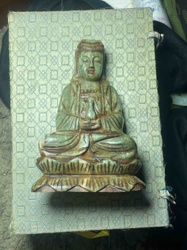
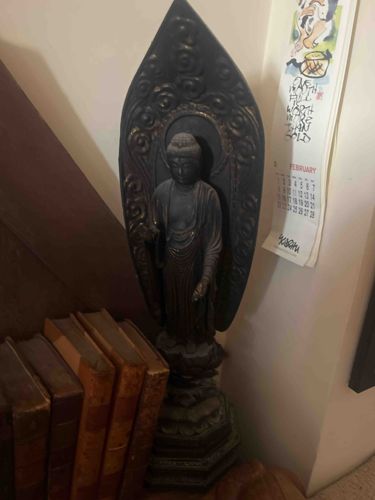
This is a cast bronze figurine depicting the Standing Amida Buddha (Amitabha), a central figure in Pure Land Buddhism. The piece is characterized by a dark, aged patina with remnants of possible gilding in the recessed areas of the mandorla. The figure stands on a multi-tiered lotus pedestal, which is set upon a hexagonal base, both common iconographic elements representing purity and enlightenment. Behind the Buddha is a large, almond-shaped flaming mandorla (nimbus) decorated with intricate scrollwork and clouds. The Buddha is depicted with traditional elongated earlobes, snail-shell curls on the head (ushnisha), and flowing robes with rhythmic, linear drapery. The height appears to be roughly 12 to 15 inches based on the scale of the accompanying books. The condition shows surface wear and dust accumulation, with some minor oxidation suggestive of an early 20th-century or late Meiji-era production. The craftsmanship is refined, particularly visible in the balanced proportions and the delicate casting of the facial features. No maker's marks are immediately visible in the image, but such pieces were frequently produced in Japan for both devotional use and export.
AI-Generated Appraisal Disclaimer
Estimated Value
$450.00 - $650.00
Basic Information
Category
Asian Art and Antiques
Appraised On
February 21, 2026
Estimated Value
$450.00 - $650.00
Item Description
This is a cast bronze figurine depicting the Standing Amida Buddha (Amitabha), a central figure in Pure Land Buddhism. The piece is characterized by a dark, aged patina with remnants of possible gilding in the recessed areas of the mandorla. The figure stands on a multi-tiered lotus pedestal, which is set upon a hexagonal base, both common iconographic elements representing purity and enlightenment. Behind the Buddha is a large, almond-shaped flaming mandorla (nimbus) decorated with intricate scrollwork and clouds. The Buddha is depicted with traditional elongated earlobes, snail-shell curls on the head (ushnisha), and flowing robes with rhythmic, linear drapery. The height appears to be roughly 12 to 15 inches based on the scale of the accompanying books. The condition shows surface wear and dust accumulation, with some minor oxidation suggestive of an early 20th-century or late Meiji-era production. The craftsmanship is refined, particularly visible in the balanced proportions and the delicate casting of the facial features. No maker's marks are immediately visible in the image, but such pieces were frequently produced in Japan for both devotional use and export.
Get Your Items Appraised
Instant estimates of your treasures with AI-powered instant appraisals