AI estimate as of September 21, 2025 · verify with a professional before acting
AI-Generated · Verify before acting
Everything on this page is generated by AI for informational purposes only. AI can make mistakes — the AI may misidentify items or misattribute them (artist, maker, brand, designer, origin, era). This is not an official valuation and should not be used for insurance, sale, tax, estate, legal, or lending purposes — or any decision requiring a certified appraisal. It is not an authoritative claim about any person, brand, or rights holder — do not share or rely on it as a factual statement about a third party. Always consult qualified professionals before making financial decisions.
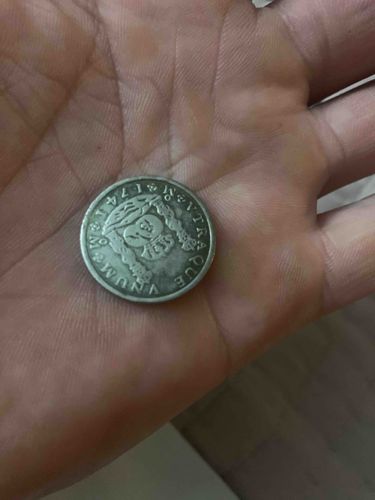
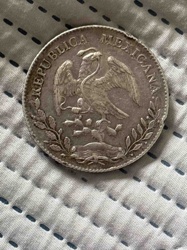
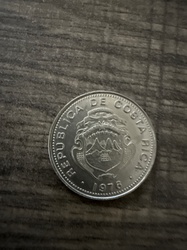
The item depicted is a silver Spanish Colonial 8 Reales coin, commonly known as a 'Pillar Dollar,' dated 1741. The coin appears to be made of silver, exhibiting the characteristic gray-white metallic luster, although some darkening and toning are visible, indicating age and oxidation typical of silver coinage. The obverse side, as shown in the image, displays what appears to be the two globes (representing the Old and New Worlds) flanked by the Pillars of Hercules, draped with a banner inscribed with the motto 'PLUS ULTRA' (More Beyond), though only 'ULTRA' is clearly legible on the right pillar and 'QUE' from 'QUE NUMA' on the left. The crown at the top is largely worn or indistinct. The date '1741' is clearly visible below the left globe. The legend surrounding the pillars is partially visible, with 'NUMA' and 'QUE' discernible on the left, and likely 'VNUM' or 'VINUM' on the right, which would typically be part of a phrase like 'VNUM.' The overall condition suggests significant circulation and wear, evidenced by the softened details, particularly on the central motifs and edges. There are no obvious deep scratches, gashes, or signs of repair, but the surface exhibits a generally smooth, worn texture. The edges appear somewhat reeded, though this is difficult to confirm definitively from the image. The craftsmanship, despite the wear, points to a machine-struck coin of the period, known for its consistent shape and design compared to earlier hammered coinage. The coin serves as a significant historical artifact, dating back to the colonial era, and its condition is consistent with an item that has been handled and circulated for centuries.
AI Appraisal Report
Based on my visual examination of the provided image, this 1741 Spanish Colonial 8 Reales 'Pillar Dollar' exhibits characteristics consistent with authentic coinage of the period. The presence of the Pillars of Hercules, the partially legible 'PLUS ULTRA' motto, and the clearly visible '1741' date all align with known specifications for these coins. The overall condition indicates significant circulation and wear, classifying it likely within the Fine (F) to Very Fine (VF) range, though a physical inspection would be crucial for a definitive grade. Details are softened, especially on the globes and crown, and parts of the legend are indistinct, which is typical for a coin that saw extensive use over centuries. There are no obvious signs of counterfeiting, such as irregular planchet shape, crude engraving, or incorrect metallic color for silver. Market conditions for these pillar dollars remain robust, with consistent demand from collectors of world coinage, particularly those focusing on colonial history. While this specific date and mint are not exceptionally rare, any authentic 18th-century pillar dollar holds inherent historical significance. The primary factor impacting its value is the wear; a higher-grade example would fetch significantly more. Without an in-person physical examination, I cannot definitively confirm its authenticity or precise metallic composition. An in-hand inspection would allow for edge examination, weight and diameter verification, and a closer look at surface details for any signs of casting, tooling, or repair. Furthermore, provenance documentation, if available, would add considerable value and certainty. Scientific testing, such as X-ray fluorescence (XRF), could confirm its silver content.