AI Appraisal Estimate

AI-generated estimates · not official valuations

From the user

What was submitted

Photo and notes provided by the user — not generated by AI

Submitted item photo
Submitted photo · June 10, 2026

User's notes

No additional notes provided.

AI analysis below

AI appraisal

AI analysis & estimate

AI-Generated · Verify before acting

Everything below is generated by AI for informational purposes only. AI can make mistakes — the AI may misidentify items or misattribute them (artist, maker, brand, designer, origin, era). This is not an official valuation and should not be used for insurance, sale, tax, estate, legal, or lending purposes — or any decision requiring a certified appraisal. It is not an authoritative claim about any person, brand, or rights holder — do not share or rely on it as a factual statement about a third party. Always consult qualified professionals before making financial decisions.

Read the full disclaimer

AI Identification

·Not independently authenticated·Verify before acting

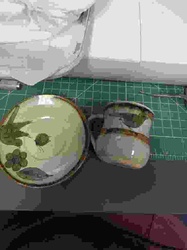
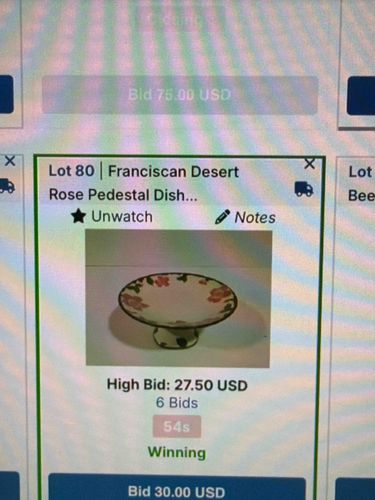
Franciscan Desert Rose Pedestal Dish

Vintage Tableware & Ceramics

AI Estimated Value

·Not an official valuation·Verify before acting

$45.00 - $65.00

As of June 10, 2026

AI Item Analysis

·AI can make mistakes·Verify before acting
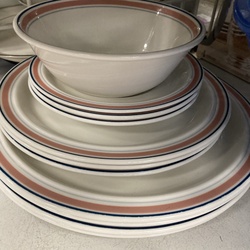
This is a vintage earthenware pedestal dish, commonly referred to as a compote or candy dish, from the iconic 'Desert Rose' pattern by Franciscan. The piece features a shallow, flared bowl supported by a short, sturdy pedestal base. It is constructed from heavy ceramic with a hand-painted floral motif. The design consists of pink five-petaled roses with yellow centers and green trailing leaves, set against a creamy off-white background. The edges of both the bowl and the foot are finished with a distinctive dark green to brownish undulating vine-like border, which is a signature element of this pattern. Typically, these pieces measure approximately 3 to 4 inches in height and 6 to 8 inches in diameter. The Franciscan Desert Rose pattern was first introduced in 1941 and became one of the most popular dinnerware designs in American history. Based on the photo, the craftsmanship shows the characteristic embossed texture where the flowers and leaves are slightly raised from the surface. Condition-wise, the visible surface appears well-preserved with vibrant colors, though such vintage items are often inspected for fine crazing in the glaze, small chips on the high-relief petals, or wear on the bottom foot ring. This specific form—the pedestal dish—was a common serving accessory produced primarily during the mid-20th century to accompany the larger dinner sets.
AI Appraisal Report

·AI can make mistakes·Verify before acting
I have virtually examined this Franciscan Desert Rose pedestal dish/compote. Based on the visual evidence, the piece exhibits the characteristic high-relief hand-painting and embossed vine border consistent with Gladding, McBean & Co. production or early Interpace-era manufacturing. The floral motifs retain vibrant pink hues, and the glaze appears to have a healthy luster, suggesting minimal dishwasher damage, which frequently plagues this pattern. Authenticity is supported by the specific molded texture and color palette typical of mid-20th-century California pottery. The market for 'Desert Rose' remains stable due to its status as the best-selling dinnerware pattern in U.S. history, though it is not considered rare. This specific pedestal form is a desirable accessory piece compared to standard bowls, though its value is moderated by high survival rates. Recent auction results for similar compotes in excellent condition range from $40 to $70. Significant value fluctuations depend on the backstamp (USA vs. England vs. China) and the presence of 'flea bites' on the delicate raised rose petals. Limitations: This appraisal is based on photographic evidence only. Visual inspection cannot definitively detect internal hairline fractures, professional restorations, or the specific backstamp used to date the piece precisely. A full authentication requires a physical examination to check for 'ring' resonance when tapped, a tactile inspection for glaze crazing, and verification of the maker's mark on the underside of the foot. Documentation of provenance or original purchase receipts would further solidify its historical context.

Get your items appraised

Instant estimates of your treasures with AI-powered appraisals

Browse More Appraisals