These notes were written by the person who submitted this item. Appraiser.AI has not verified them, and the AI's identification and estimate may rely on them.
AI Estimated Value
Not an official valuation
$25 - $40
AI estimate as of August 24, 2025 · verify with a professional before acting
AI-Generated · Verify before acting
Everything on this page is generated by AI for informational purposes only. AI can make mistakes — the AI may misidentify items or misattribute them (artist, maker, brand, designer, origin, era). This is not an official valuation and should not be used for insurance, sale, tax, estate, legal, or lending purposes — or any decision requiring a certified appraisal. It is not an authoritative claim about any person, brand, or rights holder — do not share or rely on it as a factual statement about a third party. Always consult qualified professionals before making financial decisions.
This analysis also relies on unverified notes provided by the user, which may be incomplete or inaccurate and could affect the result.
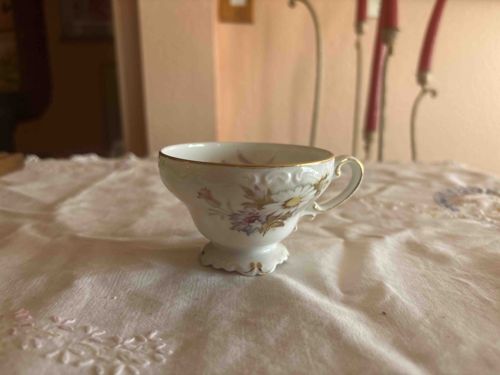
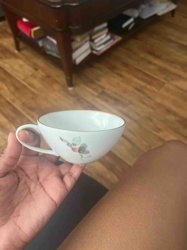
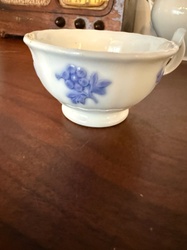
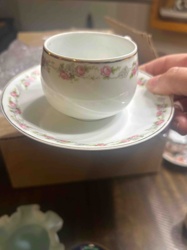
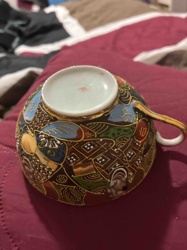
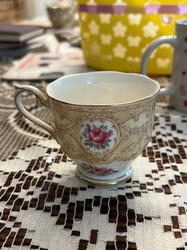
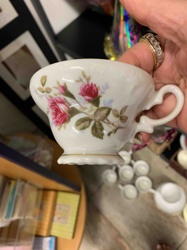
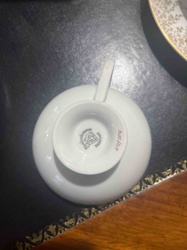
This is a single teacup, likely part of a larger tea set, made by Ohata China in Occupied Japan. The cup is crafted from fine white porcelain, exhibiting a traditional, slightly footed design with a delicate, scrolled handle. Its physical characteristics include a relatively small size, typical for a teacup, with a rounded bowl set atop a decorative, scalloped base. The primary decoration features a floral motif, with what appears to be white and yellow daisies accented by clusters of purple or lavender-colored flowers and light green leaves, possibly hand-painted given the subtle variations and brushstroke appearance. Gold trim is meticulously applied to the rim of the cup and along the top edge of the handle, indicating a certain level of elegance and quality. Another notable feature is the embossed or raised pattern visible on the exterior surface of the cup, contributing to its intricate design. The overall condition appears good for its age, with no immediate visible chips, cracks, or significant loss of the gold trim, though minor wear consistent with handling and age would be expected. The clean and bright appearance suggests it has been well-maintained. The 'Occupied Japan' marking, which is implied by the additional context, places its manufacturing period between 1945 and 1952, making it an item from the mid-20th century. This period detail is crucial for identification and valuation. The craftsmanship suggests a factory production setting, yet with careful attention to decorative detail, highlighting the quality of Japanese porcelain from that era, often made for export.
AI Appraisal Report
Based on my visual examination of the provided image and the owner's description, this Ohata China Occupied Japan Floral Porcelain Teacup appears to be a well-preserved example of mid-20th century Japanese porcelain. The "Occupied Japan" mark is crucial for dating, placing its manufacture between 1945 and 1952. Condition appears good; I note no visible chips, cracks, or significant loss to the gold trim, which is positive. The vibrant floral motif with white/yellow daisies, purple accents, and gold trim suggests a desire for export quality. The embossed pattern adds to its aesthetic appeal.
Market conditions for "Occupied Japan" porcelain are steady but not high-flying. Single teacups, even from known manufacturers like Ohata, typically do not command premium prices unless part of a complete, rare set or possessing exceptional artistic merit. Comparables for individual teacups from this period and region generally range from $15-$40, depending on condition and specific design. Sets, or pieces with more intricate decoration or unique forms, naturally fetch more. Demand exists among collectors specializing in post-WWII Japanese ceramics or 'Occupied Japan' memorabilia, but it's a niche market. The rarity of a single teacup is low; however, its good condition and attractive design enhance its desirability.
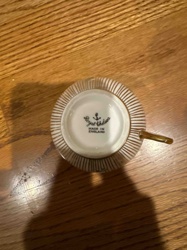
Limitations in authenticity verification from images alone are significant. While the design and description are consistent with Ohata's work from the Occupied Japan period, a physical examination would be necessary to confirm the exact maker's mark (often crucial for 'Occupied Japan' items), assess the tactile quality of the porcelain, and detect any hairline cracks, repairs, or subtle wear not visible in photographs. Provenance documentation, such as original sales receipts or family history, would further strengthen its authenticity and value. Therefore, the stated value is contingent on the accuracy of the visual assessment and owner's information.