AI Appraisal Estimate

AI-generated estimates · not official valuations

From the user

What was submitted

Photo and notes provided by the user — not generated by AI

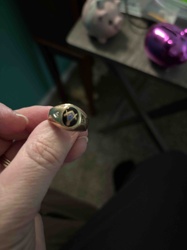
Submitted item photo
Submitted photo · June 18, 2026

User's notes

No additional notes provided.

AI analysis below

AI appraisal

AI analysis & estimate

AI-Generated · Verify before acting

Everything below is generated by AI for informational purposes only. AI can make mistakes — the AI may misidentify items or misattribute them (artist, maker, brand, designer, origin, era). This is not an official valuation and should not be used for insurance, sale, tax, estate, legal, or lending purposes — or any decision requiring a certified appraisal. It is not an authoritative claim about any person, brand, or rights holder — do not share or rely on it as a factual statement about a third party. Always consult qualified professionals before making financial decisions.

Read the full disclaimer

AI Identification

·Not independently authenticated·Verify before acting

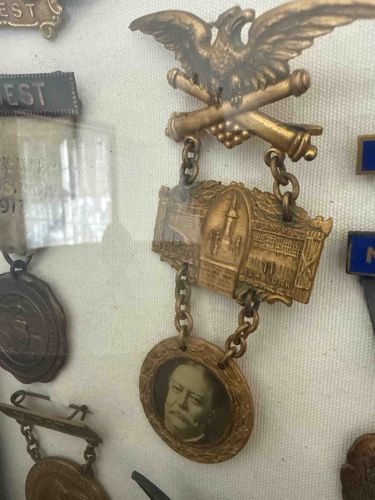
G.A.R. 45th National Encampment Delegate Badge (Rochester, NY 1911)

Militaria and Fraternal Organization Memorabilia

AI Estimated Value

·Not an official valuation·Verify before acting

$175.00 - $250.00

As of June 18, 2026

AI Item Analysis

·AI can make mistakes·Verify before acting
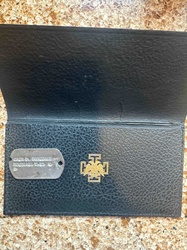
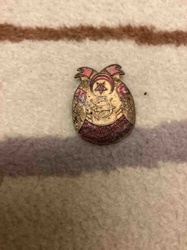
This is a multi-part commemorative metal badge issued for the 1911 Grand Army of the Republic (G.A.R.) 45th National Encampment held in Rochester, New York. The badge is constructed from a die-struck brass or bronze alloy with a gold-tone wash. The top header features a spread-wing federal eagle perched atop crossed cannons, a symbol of the Union artillery. Suspended by two short chains is a rectangular ornate middle plaque depicting a relief of a Victorian-era industrial or government building, likely Rochester's City Hall or a similar landmark, flanked by laurel wreaths and inscribed with 'NEW YORK'. The bottom pendant, hanging from a second set of chains, consists of a circular laurel wreath frame containing a sepia-toned photographic celluloid or paper inset under glass/acetate. The portrait depicts General and President William Howard Taft, who was the sitting president during the 1911 encampment. The piece shows a significant aged patina with darkening in the recessed areas of the casting. There is some minor surface oxidation and green verdigris visible on the chain links and the edge of the middle plaque. The portrait insert appears well-preserved with no significant fading or water damage. The craftsmanship is typical of early 20th-century fraternal regalia, showing high-relief stamping and decorative chain assembly.
AI Appraisal Report

·AI can make mistakes·Verify before acting
Upon visual examination of this 45th National Encampment G.A.R. Delegate Badge from 1911, I find the piece to be an authentic example of early 20th-century commemorative fraternal regalia. The badge exhibits the high-relief die-striking typical of the era, and the patina is consistent with centered oxidation of a brass/bronze alloy over 110 years. The presence of President William Howard Taft on the celluloid pendant significantly stabilizes its value, as it appeals to both G.A.R. collectors and presidential memorabilia enthusiasts. The condition is graded as 'Good to Very Good'; while the metal shows expected darkening and minor verdigris on the linkages, the celluloid portrait remains remarkably crisp without the typical 'foxing' or bubbling found in lesser-stored examples. Market demand for G.A.R. national encampment badges remains steady, particularly for major host cities like Rochester. Comparables for standard delegate badges from this period typically range from $125 to $150, but the multi-part construction and presidential association command a premium. Rarity is moderate; while these were produced in quantity for the event, finding specimens with intact chains and undamaged inserts is increasingly difficult. Limitations: This appraisal is based solely on digital images. Without an in-person examination, I cannot verify the integrity of the rear pin-back mechanism or check for hidden repairs to the chain links. Furthermore, I cannot definitively distinguish between the original gold-wash and later applications of gilt. To finalize authentication, I recommend a physical inspection to test for 'celluloid sickness' (chemical degradation) and verification of provenance to ensure the badge was not an unassembled 'parts' piece created from surplus stock.

Get your items appraised

Instant estimates of your treasures with AI-powered appraisals

Browse More Appraisals