Antique Transitional Federal/Empire Mahogany Wall Mirror
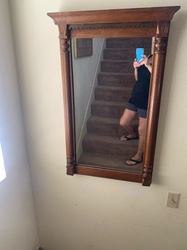
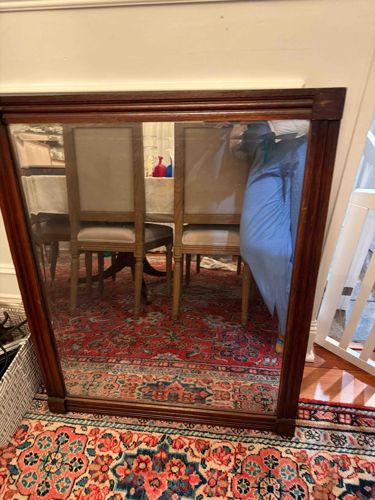
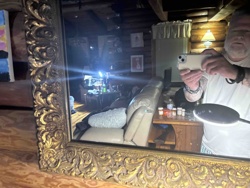
This is a rectangular wall mirror featuring a frame likely constructed from mahogany or a similarly dense-grained hardwood with a deep reddish-brown finish. The design aesthetic sits between the late Federal and early Empire periods, characterized by a stepped cornice-style header and vertical stiles with reeded or fluted detailing that mimics architectural columns. The corners are punctuated by square plinth-like blocks, a hallmarks of early 19th-century American or English furniture. The mirror glass itself appears to be a later replacement or is in remarkably well-preserved condition, as it lacks the heavy desilvering or 'foxing' typically seen in original 1800s mercury-dipped glass. Regarding physical condition, the wooden frame shows visible signs of age and wear: there are noticeable scuffs and finish loss on the upper right corner block and along the top edge. The wood demonstrates a rich, aged patina with minor abrasions consistent with its estimated age of late 19th to early 20th century if it is a revival piece, or early 19th century if original. No visible maker's marks or signatures are present in the provided image. The construction suggests solid joinery, though many such mirrors originally featured a split-column 'cushion' frame style, whereas this version uses more formal, linear reeding.
AI-Generated Appraisal Disclaimer
Estimated Value
$450 - $650
Basic Information
Category
Antique Furniture & Mirrors
Appraised On
March 28, 2026
Estimated Value
$450 - $650
Item Description
This is a rectangular wall mirror featuring a frame likely constructed from mahogany or a similarly dense-grained hardwood with a deep reddish-brown finish. The design aesthetic sits between the late Federal and early Empire periods, characterized by a stepped cornice-style header and vertical stiles with reeded or fluted detailing that mimics architectural columns. The corners are punctuated by square plinth-like blocks, a hallmarks of early 19th-century American or English furniture. The mirror glass itself appears to be a later replacement or is in remarkably well-preserved condition, as it lacks the heavy desilvering or 'foxing' typically seen in original 1800s mercury-dipped glass. Regarding physical condition, the wooden frame shows visible signs of age and wear: there are noticeable scuffs and finish loss on the upper right corner block and along the top edge. The wood demonstrates a rich, aged patina with minor abrasions consistent with its estimated age of late 19th to early 20th century if it is a revival piece, or early 19th century if original. No visible maker's marks or signatures are present in the provided image. The construction suggests solid joinery, though many such mirrors originally featured a split-column 'cushion' frame style, whereas this version uses more formal, linear reeding.
Get Your Items Appraised
Instant estimates of your treasures with AI-powered instant appraisals