Paleolithic-Style Chert Multi-Tool / Hand Axe Scraper
Prehistoric Lithic Artifacts / Archaeological Antiquities

Paleolithic-Style Chert Multi-Tool / Hand Axe Scraper

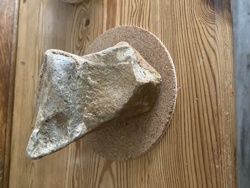
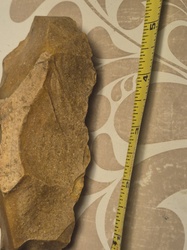
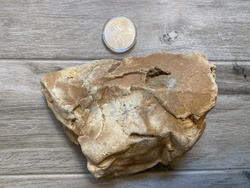
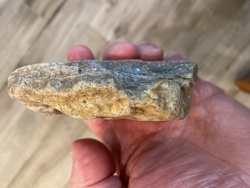
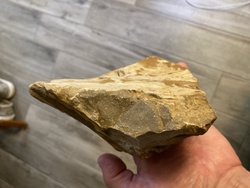
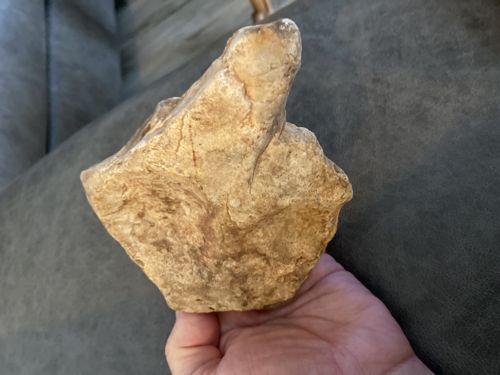
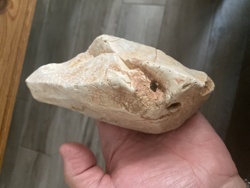
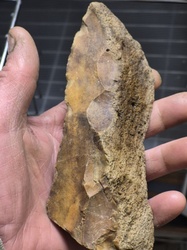
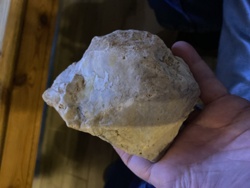
This specimen is a lithic artifact consistent with the morphology of an early multi-purpose tool, specifically identified as a chert hand axe or scraper. Measuring approximately 4.25 inches by 5 inches, the item is crafted from a light-colored, tan-to-beige chert or flint material, which is a cryptocrystalline sedimentary rock known for its predictable conchoidal fracturing. The construction exhibits evidence of hand-knapping, featuring a thick, bulbous base known as a 'butt' or 'cortex' which is ergonomically shaped to fit the palm of the hand. The tool tapers significantly to a distinct, elongated point or 'beak' at the tip, which typically served for piercing or precision cutting. Along the peripheral edges, there is evidence of unifacial or bifacial flaking, creating a robust serrated edge suitable for scraping hides or butchering. The surface shows a significant degree of patination and mineralization, a natural weathering process that occurs over thousands of years as the stone is exposed to soil minerals and groundwater. This patina gives the stone its characteristic yellowish-brown staining and a softened, matte texture across the flake scars. There are no modern saw marks or mechanical polishing evident; instead, the relief is typical of percussion flaking with visible bulbs of force and hinge fractures. Its provenance in Guthrie, Oklahoma, suggests a North American origin, potentially associated with early hunter-gatherer populations. The condition appears stable with no recent cracks or modern breaks, though it bears the expected wear and 'desert varnish' of an ancient lithic tool.
Estimated Value

$150 - $350

Basic Information

Category

Prehistoric Lithic Artifacts / Archaeological Antiquities

Appraised On

February 28, 2026

Estimated Value

$150 - $350

Additional Details Provided By Owner

User Provided Information

Early Paleolithic chert hand axe scraper multi tool found in Guthrie Ok measuring 4.25" x 5"

Item Description

This specimen is a lithic artifact consistent with the morphology of an early multi-purpose tool, specifically identified as a chert hand axe or scraper. Measuring approximately 4.25 inches by 5 inches, the item is crafted from a light-colored, tan-to-beige chert or flint material, which is a cryptocrystalline sedimentary rock known for its predictable conchoidal fracturing. The construction exhibits evidence of hand-knapping, featuring a thick, bulbous base known as a 'butt' or 'cortex' which is ergonomically shaped to fit the palm of the hand. The tool tapers significantly to a distinct, elongated point or 'beak' at the tip, which typically served for piercing or precision cutting. Along the peripheral edges, there is evidence of unifacial or bifacial flaking, creating a robust serrated edge suitable for scraping hides or butchering. The surface shows a significant degree of patination and mineralization, a natural weathering process that occurs over thousands of years as the stone is exposed to soil minerals and groundwater. This patina gives the stone its characteristic yellowish-brown staining and a softened, matte texture across the flake scars. There are no modern saw marks or mechanical polishing evident; instead, the relief is typical of percussion flaking with visible bulbs of force and hinge fractures. Its provenance in Guthrie, Oklahoma, suggests a North American origin, potentially associated with early hunter-gatherer populations. The condition appears stable with no recent cracks or modern breaks, though it bears the expected wear and 'desert varnish' of an ancient lithic tool.
Get Your Items Appraised

Instant estimates of your treasures with AI-powered instant appraisals

Browse More Appraisals