American Brilliant Period Nappy with Loop Handle
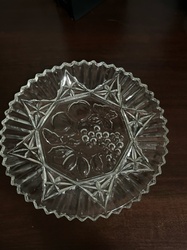
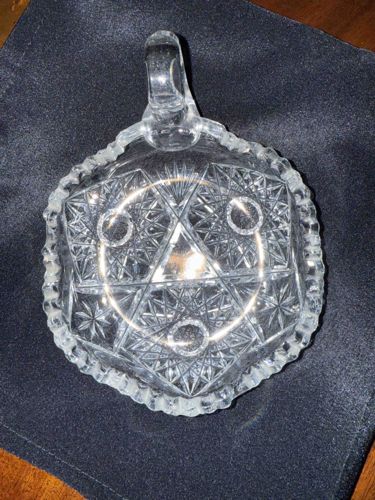
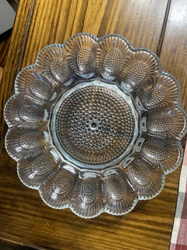
This item is a circular, shallow glass dish known as a nappy, featuring a single applied loop handle. The piece is crafted from heavy, high-clarity lead crystal, characteristic of the American Brilliant Period (circa 1880-1915). Its intricate geometric motif includes deeply cut miter lines forming a central triangular framework, surrounded by hobstar and fan patterns. The rim is finished with a rhythmic sawtooth or scalloped edge, a sign of high-quality craftsmanship where each tooth is meticulously hand-cut. The handle is smoothly polished, providing a tactile contrast to the sharp, multi-faceted body. While no maker's mark is immediately visible in the image—which is common for this period—the complexity of the design suggests a skilled manufacturer such as Libbey or Hawkes. The glass displays a brilliant 'water-white' quality with excellent light refraction. Visible condition appears good with no major cracks or heavy clouding, though minor 'flea bite' nicks along the sharp edges of the sawtooth rim are expected given its age. This piece serves as a prime example of late 19th-century utilitarian art glass, designed for serving small items like mints or nuts.
AI-Generated Appraisal Disclaimer
Estimated Value
$125 - $175
Basic Information
Category
Antique Glassware
Appraised On
January 11, 2026
Estimated Value
$125 - $175
Additional Details Provided By Owner
User Provided Information
Cut glass. Age unknown.
Item Description
This item is a circular, shallow glass dish known as a nappy, featuring a single applied loop handle. The piece is crafted from heavy, high-clarity lead crystal, characteristic of the American Brilliant Period (circa 1880-1915). Its intricate geometric motif includes deeply cut miter lines forming a central triangular framework, surrounded by hobstar and fan patterns. The rim is finished with a rhythmic sawtooth or scalloped edge, a sign of high-quality craftsmanship where each tooth is meticulously hand-cut. The handle is smoothly polished, providing a tactile contrast to the sharp, multi-faceted body. While no maker's mark is immediately visible in the image—which is common for this period—the complexity of the design suggests a skilled manufacturer such as Libbey or Hawkes. The glass displays a brilliant 'water-white' quality with excellent light refraction. Visible condition appears good with no major cracks or heavy clouding, though minor 'flea bite' nicks along the sharp edges of the sawtooth rim are expected given its age. This piece serves as a prime example of late 19th-century utilitarian art glass, designed for serving small items like mints or nuts.
Get Your Items Appraised
Instant estimates of your treasures with AI-powered instant appraisals