AI estimate as of June 27, 2025 · verify with a professional before acting
AI-Generated · Verify before acting
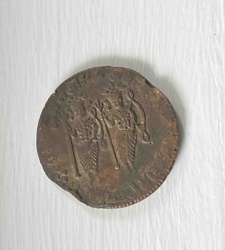
Everything on this page is generated by AI for informational purposes only. AI can make mistakes — the AI may misidentify items or misattribute them (artist, maker, brand, designer, origin, era). This is not an official valuation and should not be used for insurance, sale, tax, estate, legal, or lending purposes — or any decision requiring a certified appraisal. It is not an authoritative claim about any person, brand, or rights holder — do not share or rely on it as a factual statement about a third party. Always consult qualified professionals before making financial decisions.
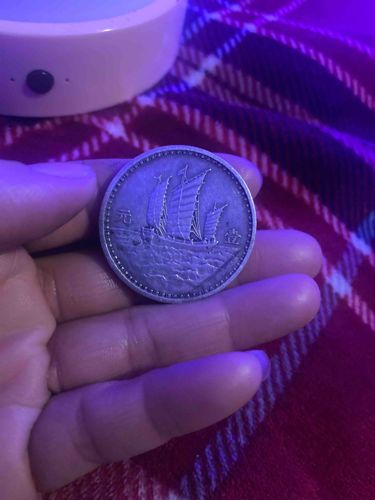
This item is a circular metallic coin, appearing to be composed of silver due to its characteristic luster and toning, which has taken on a dark, almost charcoal-grey patina, particularly in the recessed areas of the design. The coin's size is consistent with that of a standard silver dollar. The visible side, likely the obverse, prominently features a detailed depiction of a traditional Chinese junk ship with multiple sails unfurled, navigating through ocean waves. The intricate details of the ship's rigging, sails, and hull are discernible, showcasing the craftsmanship. To the right of the ship, two Chinese characters are visible, "壹圓" (Yī Yuán), signifying its denomination as 'One Yuan'. On the left side, another Chinese character is present, which is likely part of the year of mintage according to the Minguo calendar system. The coin's edge is adorned with a decorative reeded or dotted pattern. In terms of condition, the coin exhibits notable signs of circulation, including surface scratches, minor dings, and overall wear consistent with its age and use. The natural toning has developed unevenly, indicating its authenticity as an older piece rather than a modern reproduction. Despite the wear and toning, the core design elements remain clear and easily identifiable. This particular type of coin is widely recognized as a "Junk Dollar" from the Republic of China period, specifically minted between 1932 and 1934. Its design is emblematic of the early 20th-century Chinese Republic and represents an important piece of Chinese numismatic history, reflecting the nation's maritime heritage. The quality of the original strike appears to be high, typical for national coinage, with well-defined elements despite the subsequent wear.
AI Appraisal Report
Having virtually examined the Republic of China Junk Dollar based on your detailed description, I can offer the following appraisal. The coin's appearance, described as silver-like with an uneven, dark charcoal-grey patina, is consistent with an authentic aged silver coin. The clear depiction of the junk ship, the "壹圓" denomination, and the presence of a Minguo year character strongly identify this as a genuine Republic of China Junk Dollar, likely from the 1932-1934 period. The reported "notable signs of circulation, including surface scratches, minor dings, and overall wear" indicates a condition in the Very Fine to Extra Fine range. The fact that "core design elements remain clear and easily identifiable" is a positive sign for its grade within circulation.
Market demand for Chinese numismatics, particularly historically significant pieces like the Junk Dollar, is consistently strong. While not exceptionally rare in circulated condition, their historical importance and iconic design ensure steady collector interest. Comparables would be other authenticated Junk Dollars of similar circulated grades.
Factors heavily impacting value are primarily condition and confirmed authenticity. The described wear detracts from top-tier value, but its clear details maintain desirability. My appraisal value is based on the assumption of authenticity. However, it's crucial to state that full authentication cannot be achieved through description alone. True verification would require a physical examination to ascertain precise weight, diameter, thickness, specific gravity, edge details, and the nuances of the strike under magnification. Scientific testing might be needed if any doubts arise. Without these, the possibility of an expertly crafted replica, though less likely given the described natural toning, cannot be entirely dismissed. Provenance documentation would also add significant value and certainty.