AI Appraisal Estimate

AI-generated estimates · not official valuations

From the user

What was submitted

Photo and notes provided by the user — not generated by AI

Submitted item photo
Submitted photo · June 15, 2026

User's notes

No additional notes provided.

AI analysis below

AI appraisal

AI analysis & estimate

AI-Generated · Verify before acting

Everything below is generated by AI for informational purposes only. AI can make mistakes — the AI may misidentify items or misattribute them (artist, maker, brand, designer, origin, era). This is not an official valuation and should not be used for insurance, sale, tax, estate, legal, or lending purposes — or any decision requiring a certified appraisal. It is not an authoritative claim about any person, brand, or rights holder — do not share or rely on it as a factual statement about a third party. Always consult qualified professionals before making financial decisions.

Read the full disclaimer

AI Identification

·Not independently authenticated·Verify before acting

West African Bronze Kneeling Female Figure

Antique African Tribal Art

AI Estimated Value

·Not an official valuation·Verify before acting

$400 - $850

As of June 15, 2026

AI Item Analysis

·AI can make mistakes·Verify before acting
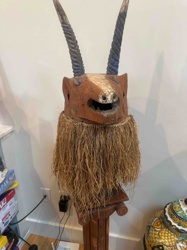
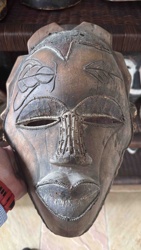
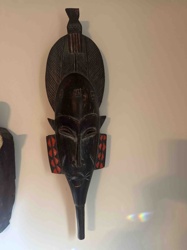
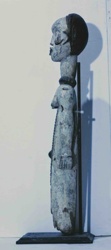
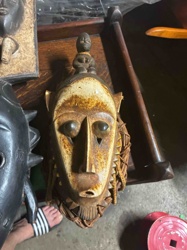
This is a hand-cast bronze or brass alloy sculpture depicting a kneeling female figure, traditional in the style of West African metalwork, likely from the Yoruba or Edo people (Benin Kingdom influence). The figure stands approximately 10-14 inches tall, though exact dimensions require physical measurement. It features an elongated, stylized head topped with a conical, horned, or peaked headdress. The facial features are prominent, with large almond-shaped eyes, a broad nose, and thick lips. The surface exhibits a heavy green and black verdigris patina, indicating oxidation over time, with scattered reddish-brown earth encrustations that may suggest burial or long-term outdoor exposure. The figure's hands are positioned near a large leaf-like or shield-like protrusion at the waist. There are vertical scarification markings visible on the torso and face, which are typical cultural identifiers. The quality of the casting is rustic, showing the texture of the lost-wax (cire perdue) process, with some pitting and blunt edges. The base is irregular and integral to the cast. Condition issues include significant surface corrosion, encrusted dirt in the crevices, and minor blunting of the finer details, consistent with an age ranging from the late 19th to the mid-20th century. No visible maker's marks or signatures are present, as is common for traditional tribal ritual or courtly objects.
AI Appraisal Report

·AI can make mistakes·Verify before acting
I have carefully examined the provided images of this West African bronze kneeling female figure, likely of Yoruba origin (Ogboni society influence) or Bida manufacture. The sculpture exhibits the characteristic features of the 'cire perdue' (lost-wax) casting method, notably the rustic texture and integral base. The heavy malachite-green verdigris and presence of laterite-soil encrustations suggest a significant period of environmental exposure, possibly burial. However, the uniformity of the corrosion can sometimes be artificially induced in 'tourist-market' pieces to simulate age. The lack of refinement in the facial casting and the bluntness of the scarification marks suggest this may be a mid-20th-century piece rather than a 19th-century courtly antiquity. The market for West African bronze is currently bifurcated; authenticated pre-colonial pieces fetch five-figure sums, while mid-century decorative tribal art remains steady in the $400-$900 range. Without a physical scratch test to verify the depth of the patina or metallurgical analysis (XRF) to determine the copper-to-zinc ratio, it is impossible to definitively confirm the age. Furthermore, the absence of provenance—the history of ownership—significantly limits the valuation. To elevate this appraisal to a 'fine art' category, documentation tracing its export to prior to the 1970 UNESCO Convention would be required. In its current state, the value reflects its merit as a high-quality cultural decorative object with significant aesthetic appeal and traditional form.

Get your items appraised

Instant estimates of your treasures with AI-powered appraisals

Browse More Appraisals