AI estimate as of December 13, 2025 · verify with a professional before acting
AI-Generated · Verify before acting
Everything on this page is generated by AI for informational purposes only. AI can make mistakes — the AI may misidentify items or misattribute them (artist, maker, brand, designer, origin, era). This is not an official valuation and should not be used for insurance, sale, tax, estate, legal, or lending purposes — or any decision requiring a certified appraisal. It is not an authoritative claim about any person, brand, or rights holder — do not share or rely on it as a factual statement about a third party. Always consult qualified professionals before making financial decisions.
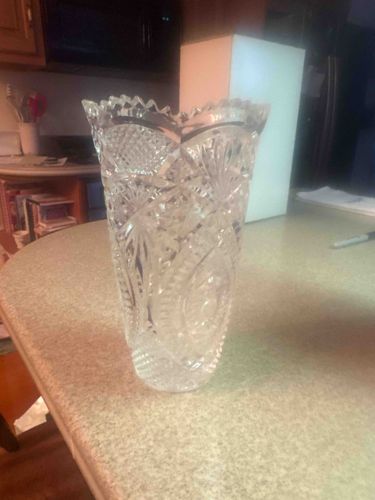
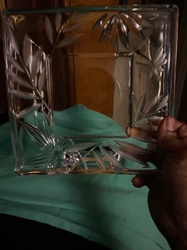
This is a clear, colorless cut glass vase, likely made of lead crystal given its brilliant sparkle and intricate faceting. The vase features a flared, scalloped rim that gives it an ornate and decorative top edge. The body of the vase is adorned with a complex pattern of precision-cut geometric designs, including what appears to be hobstar motifs, fan cuts, and possibly diamond or crosshatch patterns, typical of the brilliant cut glass era. The cutting creates a multitude of reflective surfaces that catch and refract light effectively. It has a cylindrical or slightly tapered form, broadening towards the top, and sits on a relatively narrow, flat base. Due to the high number of intricate cuts, it suggests good craftsmanship and attention to detail. No significant chips, cracks, or repairs are immediately visible, indicating it is in good, possibly excellent, condition. The clarity of the glass suggests it has been well-maintained, with no noticeable fogging or mineral deposits. Without maker's marks, it's difficult to pinpoint an exact origin, but the style of cutting is characteristic of American Brilliant Cut Glass, popular from approximately 1876 to 1916, or European crystal manufacturers from a similar period. It could also be a later reproduction or a piece from the mid-20th century that emulated earlier styles. The substantial weight suggested by the thickness of the glass, combined with the detailed cutting, points to a quality decorative item.
AI Appraisal Report
This clear, colorless cut glass vase, likely lead crystal due to its brilliant sparkle, exhibits a flared, scalloped rim and a complex pattern of geometric designs, including apparent hobstar, fan, and possibly diamond cuts. Its form is cylindrical, slightly broadening towards the top, resting on a narrow, flat base. Based on the provided description, the condition appears good to excellent, with no visible chips, cracks, or repairs and no noticeable fogging. The intricate cutting suggests good craftsmanship.
Authenticity is a key factor here. The style is characteristic of American Brilliant Cut Glass (1876-1916) or European crystal from a similar period. However, it could also be a later reproduction or mid-20th-century piece emulating earlier styles. Without maker's marks, definitive attribution is challenging. The market for general Brilliant Cut Glass pieces varies significantly based on maker, specific pattern rarity, and condition. While detailed, this piece does not immediately present as a rare or highly sought-after pattern from a top-tier manufacturer, which would command premium prices.
Factors impacting value include its good condition and elaborate cutting. However, the lack of a known maker, specific provenance, and the general abundance of similar cut glass pieces in the current market temper its potential value. Demand for unidentifiable cut glass, while present, is typically not high enough to drive prices for common patterns above a modest range.
Limitations: My assessment is based solely on the provided description. A physical examination is crucial to confirm the absence of subtle damage (flea bites, internal cracks), assess the glass quality (lead content, clarity), and search for obscured maker's marks. Microscopic analysis of the cuts could differentiate between hand-cut and machine-cut, influencing authenticity and value. Provenance documentation or scientific testing would be needed for a definitive authentication of origin and period.