Native American Lithic Multi-Tool / Scraper
Prehistoric Artifacts / Native American Lithics

Native American Lithic Multi-Tool / Scraper

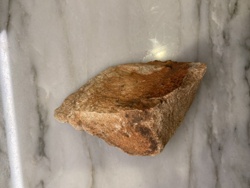
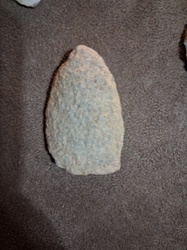
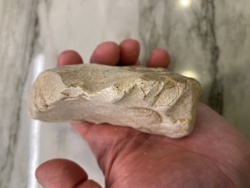
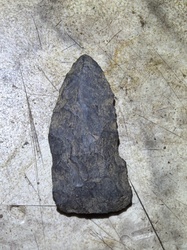
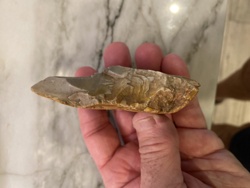
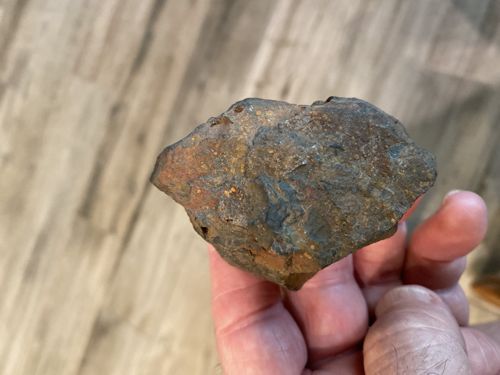
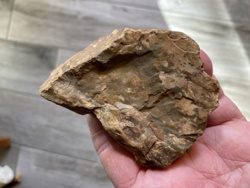
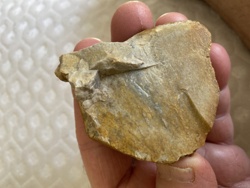
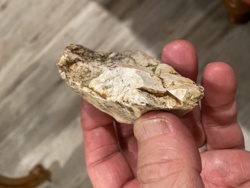
This specimen is a prehistoric stone tool, identified as a multi-functional lithic implement, likely a combination scraper and chopper. Measuring approximately 2" x 2", the item fits the profile of a handheld 'expedient tool' common to various North American cultural periods. The material appears to be a local sedimentary or metamorphic stone, possibly a ferruginous sandstone or low-grade chert, common in the Guthrie, Oklahoma region. The coloring is a complex mixture of hematite-rich reds, ochre yellows, and dark charcoal grays, suggesting high mineral content and significant surface oxidation from long-term burial in the soil. Physically, the item shows evidence of intentional percussion flaking along one or more edges to create a working surface. There is a visible bulb of percussion and several shallow flake scars on the dominant face, indicating anthropogenic modification rather than natural tumbling. The condition shows heavy environmental patina and rounded edges, which are consistent with an Archaic period age (approx. 8,000 to 3,000 years ago). There is no modern mechanical damage, though there are natural pits and inclusions typical of the base stone material. The ergonomics of the piece suggest it was designed to be held between the thumb and forefingers for hide scraping or plant processing. The lack of a formal hafting element (notching) classifies this as a hand-held tool rather than a projectile point. The craftsmanship is functional rather than aesthetic, representing a utilitarian object used for daily survival tasks.
Estimated Value

$15.00 - $35.00

Basic Information

Category

Prehistoric Artifacts / Native American Lithics

Appraised On

February 17, 2026

Estimated Value

$15.00 - $35.00

Additional Details Provided By Owner

User Provided Information

Prehistoric stone multi tool found in Guthrie OK measuring 2" x 2"

Item Description

This specimen is a prehistoric stone tool, identified as a multi-functional lithic implement, likely a combination scraper and chopper. Measuring approximately 2" x 2", the item fits the profile of a handheld 'expedient tool' common to various North American cultural periods. The material appears to be a local sedimentary or metamorphic stone, possibly a ferruginous sandstone or low-grade chert, common in the Guthrie, Oklahoma region. The coloring is a complex mixture of hematite-rich reds, ochre yellows, and dark charcoal grays, suggesting high mineral content and significant surface oxidation from long-term burial in the soil. Physically, the item shows evidence of intentional percussion flaking along one or more edges to create a working surface. There is a visible bulb of percussion and several shallow flake scars on the dominant face, indicating anthropogenic modification rather than natural tumbling. The condition shows heavy environmental patina and rounded edges, which are consistent with an Archaic period age (approx. 8,000 to 3,000 years ago). There is no modern mechanical damage, though there are natural pits and inclusions typical of the base stone material. The ergonomics of the piece suggest it was designed to be held between the thumb and forefingers for hide scraping or plant processing. The lack of a formal hafting element (notching) classifies this as a hand-held tool rather than a projectile point. The craftsmanship is functional rather than aesthetic, representing a utilitarian object used for daily survival tasks.
Get Your Items Appraised

Instant estimates of your treasures with AI-powered instant appraisals

Browse More Appraisals