AI Appraisal Estimate

AI-generated estimates · not official valuations

From the user

What was submitted

Photo and notes provided by the user — not generated by AI

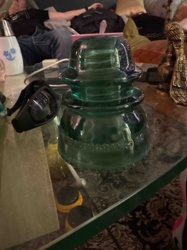
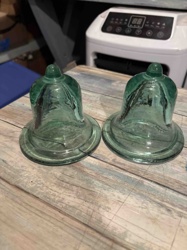
Submitted item photo
Submitted photo · June 30, 2026

User's notes

No additional notes provided.

AI analysis below

AI appraisal

AI analysis & estimate

AI-Generated · Verify before acting

Everything below is generated by AI for informational purposes only. AI can make mistakes — the AI may misidentify items or misattribute them (artist, maker, brand, designer, origin, era). This is not an official valuation and should not be used for insurance, sale, tax, estate, legal, or lending purposes — or any decision requiring a certified appraisal. It is not an authoritative claim about any person, brand, or rights holder — do not share or rely on it as a factual statement about a third party. Always consult qualified professionals before making financial decisions.

Read the full disclaimer

AI Identification

·Not independently authenticated·Verify before acting

Hemingray No. 42 Glass Insulator

Antique Industrial Glassware / Collectible Insulators

AI Estimated Value

·Not an official valuation·Verify before acting

$5.00 - $12.00

As of June 30, 2026

AI Item Analysis

·AI can make mistakes·Verify before acting
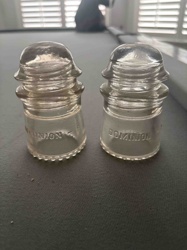
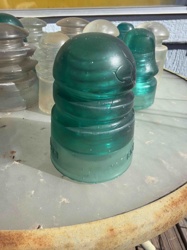
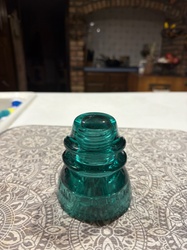
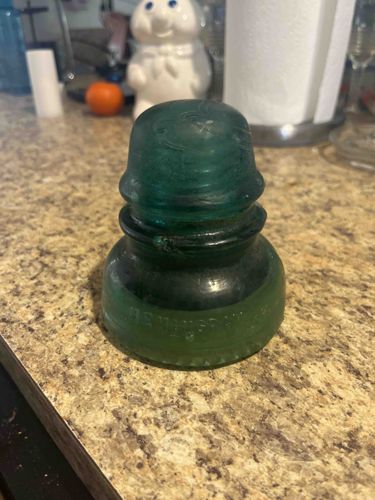
This is a vintage glass electrical insulator, specifically a Hemingray No. 42 model, which was a standard for telephone and telegraph lines in North America. The item is crafted from heavy, thick-walled pressed glass in a deep green hue, often referred to in collecting circles as 'Hemingray Blue' or 'Aqua Green' depending on light saturation. It features a tiered, bell-shaped design with a rounded 'dome' top, an middle wire groove for securing lines, and a flared 'petticoat' base. Embossed on the lower skirt is the clearly visible manufacturer's mark 'HEMINGRAY-42', likely accompanied by a 'MADE IN U.S.A.' stamp on the reverse side. The interior is threaded to allow it to be screwed onto wooden crossarm pins. In terms of condition, there is a prominent chip or 'flea bite' on the middle ridge, which is common for these industrial artifacts after years of outdoor service. There is a visible layer of surface grime and soot, particularly in the grooves, which is a natural patina for insulators exposed to coal-fired train smoke or environmental pollution. The base appears to have 'drip points' (small teeth-like projections), which was a design feature intended to help water shed away from the pin. Given the markings, this piece likely dates from the 1920s to the 1950s.
AI Appraisal Report

·AI can make mistakes·Verify before acting
I have conducted a visual examination of the provided Hemingray No. 42 glass insulator. The piece appears to be an authentic example of a mid-20th-century communications artifact, likely manufactured between 1921 and 1950. The 'aqua' color and 'drip point' base are characteristic of the massive production runs Hemingray executed at their Muncie, Indiana plant. In terms of condition, I note a significant chip on the wire ridge and heavy surface soot contamination. While the patina provides historical context of its service near railroads, the 'flea bite' and larger chips are detrimental to the value in a market that prioritizes mint-condition glass. The Hemingray No. 42 is arguably the most common antique insulator in existence, with millions produced. Unlike rare colors like 'Cobalt Blue' or 'Electric Green,' the aqua variety is ubiquitous. Current market demand is driven primarily by decorators and entry-level collectors; however, supply remains high, keeping prices low. Comparables sold on major auction platforms frequently fluctuate between $5 and $15 depending on the clarity of the embossing. Please note that a photograph cannot reveal internal 'stress cracks' or 'seed bubbles' which are vital for a complete structural assessment. Furthermore, while the markings look consistent with period molds, the abundance of these items makes forgeries unlikely, yet a physical inspection is required to confirm the glass density and the presence of any modern chemical coatings used to enhance luster. A full authentication would require a hands-on examination to check for 're-dipped' edges or concealed fractures.

Get your items appraised

Instant estimates of your treasures with AI-powered appraisals

Browse More Appraisals