AI Appraisal Estimate

AI-generated estimates · not official valuations

From the user

What was submitted

Photo and notes provided by the user — not generated by AI

Submitted item photo
Submitted photo · June 25, 2026

User's notes

No additional notes provided.

AI analysis below

AI appraisal

AI analysis & estimate

AI-Generated · Verify before acting

Everything below is generated by AI for informational purposes only. AI can make mistakes — the AI may misidentify items or misattribute them (artist, maker, brand, designer, origin, era). This is not an official valuation and should not be used for insurance, sale, tax, estate, legal, or lending purposes — or any decision requiring a certified appraisal. It is not an authoritative claim about any person, brand, or rights holder — do not share or rely on it as a factual statement about a third party. Always consult qualified professionals before making financial decisions.

Read the full disclaimer

AI Identification

·Not independently authenticated·Verify before acting

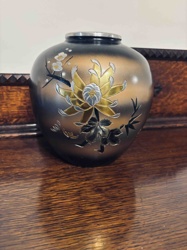
Pair of Japanese Ginbari Cloisonné Enamel Vases

Asian Antiques / Japanese Metalwork

AI Estimated Value

·Not an official valuation·Verify before acting

$450 - $650

As of June 25, 2026

AI Item Analysis

·AI can make mistakes·Verify before acting
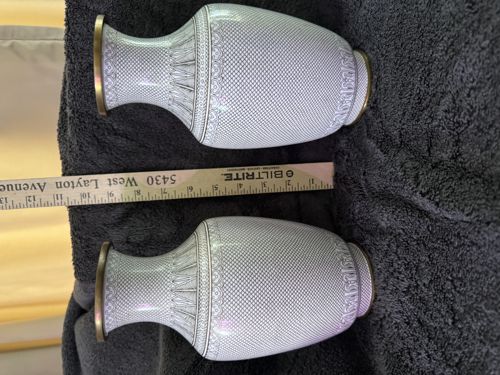
This is a matched pair of Japanese Ginbari cloisonné vases, likely dating from the Meiji (1868-1912) to early Showa era. Each vase stands approximately 7 to 8 inches tall, based on the accompanying ruler. The vessels are crafted using the 'Ginbari' technique, which involves applying translucent enamel over a textured foil base—in this case, a fine 'ghilloche' or fish-scale pattern that catches and reflects light through the white/pale lavender enamel. The neck features intricate foliate or petal-shaped panels, while the shoulder and base are decorated with repeating geometric and floral bands. The rims and bases are finished with brass or gilded metal mounts. The construction exhibits high-quality craftsmanship, characterized by the precise placement of thin wire cloisons and the uniformity of the translucent glaze. Visible condition appears good with the metal rims showing a natural darkened patina consistent with age. There are no obvious 'pitted' areas or 'spider' cracks visible in the photo, though such items require close inspection for internal enamel hairlines known as 'crazing'. The pair exhibits a classic baluster form with a flared neck, representing a refined example of Japanese decorative arts intended for the export market.
AI Appraisal Report

·AI can make mistakes·Verify before acting
I have virtually examined this pair of Japanese Ginbari cloisonné vases. The pieces exhibit the hallmark characteristics of the late Meiji to early Taisho era (1880-1925), specifically the 'tsuiki-jippo' technique where translucent enamel is fired over a debossed silver-foil ground. The fish-scale (seigaiha-style) foil creates a luminous depth highly prized by collectors of export-ware. The execution of the floral motifs and geometric borders indicates a high level of workshop skill, consistent with the quality produced for the Western market. Based on the images, the condition appears excellent with a desirable aged patina on the brass mounts; however, internal stress fractures or 'crazing'—common in Ginbari due to different expansion rates of metal and glass—cannot be definitively ruled out without a high-intensity light inspection. The market for Japanese metalwork remains steady, though values for unsigned Ginbari have softened compared to signed masterpieces by artists like Ando Jubei. Comparables for matched pairs in this size and condition typically realize between $400 and $700 at auction. Significant value is added by the fact they remain a matched pair. Limitations: This appraisal is based on photographic evidence only. A physical inspection is required to verify the absence of 'pitting' or professional restoration. I would also need to check the underside of the mounts for any maker marks. Scientific testing such as X-ray fluorescence (XRF) would be necessary to confirm the silver content of the foil if purity is questioned, though visual assessment strongly suggests period-accurate materials.

Get your items appraised

Instant estimates of your treasures with AI-powered appraisals

Browse More Appraisals