Free-Blown Glass Bottle Fragment or 'Kick' Base
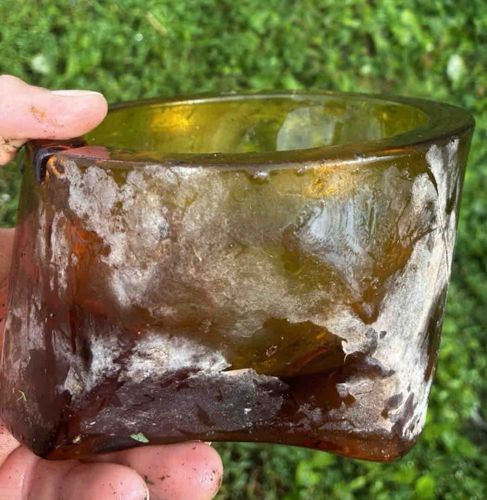
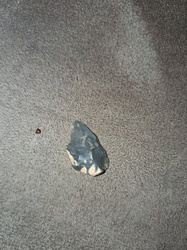
This item is the heavy, thick-walled base section of a hand-blown glass bottle, likely an early wine or spirits vessel. The glass displays a deep amber or olive-green color, commonly referred to as 'black glass' in antiquarian contexts due to its opacity in thick sections. The base features a prominent 'kick' or push-up, a structural element intended to distribute sediment and increase stability. The exterior is heavily impacted by significant iridescent weathering and 'sick glass' syndrome, appearing as a crusty, opaque white or silvery exfoliation. This occurs when glass is buried in moist, acidic soil for centuries, causing the minerals to leach out and create a laminated surface. The glass itself is filled with seed bubbles and impurities, indicating early manufacturing techniques predating standardized industrial glass. The rim where it was severed appears uneven and jagged, suggesting it is a shard from a larger vessel rather than a finished bowl. Based on the thickness, color, and degree of devitirification, this fragment likely dates from the late 17th to the mid-18th century, possibly originating from an English 'onion' or 'bladder' bottle. There are no visible maker's marks, which is typical for free-blown utility glass of this period.
AI-Generated Appraisal Disclaimer
Estimated Value
$45.00 - $75.00
Basic Information
Category
Antique Glassware / Archaeological Artifact
Appraised On
December 29, 2025
Estimated Value
$45.00 - $75.00
Item Description
This item is the heavy, thick-walled base section of a hand-blown glass bottle, likely an early wine or spirits vessel. The glass displays a deep amber or olive-green color, commonly referred to as 'black glass' in antiquarian contexts due to its opacity in thick sections. The base features a prominent 'kick' or push-up, a structural element intended to distribute sediment and increase stability. The exterior is heavily impacted by significant iridescent weathering and 'sick glass' syndrome, appearing as a crusty, opaque white or silvery exfoliation. This occurs when glass is buried in moist, acidic soil for centuries, causing the minerals to leach out and create a laminated surface. The glass itself is filled with seed bubbles and impurities, indicating early manufacturing techniques predating standardized industrial glass. The rim where it was severed appears uneven and jagged, suggesting it is a shard from a larger vessel rather than a finished bowl. Based on the thickness, color, and degree of devitirification, this fragment likely dates from the late 17th to the mid-18th century, possibly originating from an English 'onion' or 'bladder' bottle. There are no visible maker's marks, which is typical for free-blown utility glass of this period.
Related Tags
Get Your Items Appraised
Instant estimates of your treasures with AI-powered instant appraisals