AI estimate as of September 4, 2025 · verify with a professional before acting
AI-Generated · Verify before acting
Everything on this page is generated by AI for informational purposes only. AI can make mistakes — the AI may misidentify items or misattribute them (artist, maker, brand, designer, origin, era). This is not an official valuation and should not be used for insurance, sale, tax, estate, legal, or lending purposes — or any decision requiring a certified appraisal. It is not an authoritative claim about any person, brand, or rights holder — do not share or rely on it as a factual statement about a third party. Always consult qualified professionals before making financial decisions.
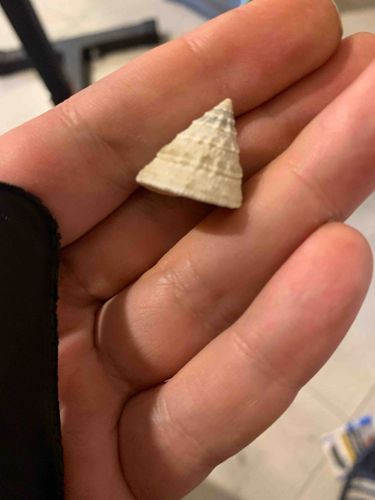
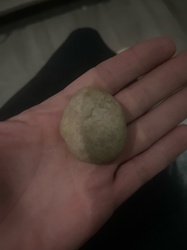
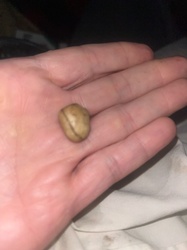
This item is a natural cone-shaped seashell, likely from a genus such as Conus, Turritella, or similar gastropod. Its dimensions appear small, fitting comfortably within the palm of an average adult hand, suggesting a size of approximately 2-3 cm in height. The material is calcium carbonate, typical of seashells, and it displays a predominantly off-white to beige coloration, with some subtle hints of a darker, possibly greyish-brown tone visible towards the apex, which could be natural pigmentation or environmental staining. The shell exhibits clear, raised ridges or whorls that spiral upward from the wider base to the pointed apex, indicating its growth pattern. These concentric lines suggest regular growth bands. The surface texture appears somewhat worn, and the edges of the ridges might be slightly smoothed from natural processes, such as tumbling in sand or water. There are no obvious signs of significant damage like chips or cracks, and the overall integrity of the shell seems sound. No visible signs of repair are present. Given its natural formation and lack of artificial markings, this is a naturally occurring specimen. Its condition suggests it was likely collected from a beach or shallow water environment, where it has undergone some wear due to natural elements. The craftsmanship details are, by definition, those of nature itself, showcasing the intricate and precise growth patterns inherent to marine gastropods. The quality is good for a naturally found object, free from severe degradation, retaining its characteristic shape and primary textural features.
AI Appraisal Report
Based on my visual examination of the provided image, this natural cone-shaped seashell appears to be an authentic specimen, likely from a common gastropod genus. Its condition is good for a naturally found object, showing typical wear consistent with collection from a beach or shallow water environment. There are no apparent chips, cracks, or signs of repair, and its characteristic shape and primary textural features are well-preserved.
Market conditions for common natural seashells of this size and type are generally very low. Comparable items, often found in novelty shops or bulk craft supplies, typically retail for minimal amounts. The demand for such a basic, unenhanced specimen is limited to hobbyists or those seeking low-cost decorative items. It is not rare; similar shells are abundant globally.
The primary factor impacting its value is its commonality and lack of unique features, such as exceptional size, rare coloration, or specific historical/scientific significance. Without these attributes, its value remains purely intrinsic as a natural curio.
Limitations in authenticity verification from image alone: While it appears natural, a physical inspection would allow me to thoroughly assess the surface texture for any artificial coatings, verify the material's integrity more precisely, and detect any subtle repairs not visible in the image. Provenance documentation, such as collection details (date, location, collector), could add minor value, particularly if linked to a specific scientific survey or historical collection, but for a common shell, this is rarely available or sought after.