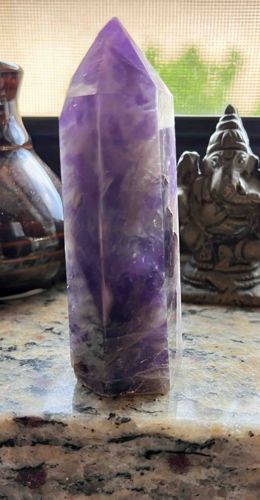
Polished Dream Amethyst Point (Chevron Amethyst Tower)
This item is a tall, hexagonal polished tower crafted from 'Dream' or 'Chevron' Amethyst, a variety of quartz characterized by its V-shaped bands of translucent purple amethyst and opaque white milky quartz. The piece stands as a vertical obelisk, tapering to a sharp, faceted point at the top. The coloration is a rich, saturated violet interspersed with chaotic white veining and internal crystalline structures that create a sense of depth. In terms of construction, the stone has been mechanically cut and polished to a high-gloss finish, though horizontal internal cleavage planes and natural fissures are visible through the surface, which is common for this gemstone type. There appear to be minor surface abrasions or 'flea bites' near the base edges, likely from handling. No maker's marks are present, as is standard for lapidary specimens of this nature. The craftsmanship is high, with straight edges and a symmetric point. Based on the style and typical market availability, this specimen likely dates to the late 20th or early 21st century and was likely sourced from deposits in Brazil or Zambia.
AI-Generated Appraisal Disclaimer
Estimated Value
$45.00 - $65.00
Basic Information
Category
Gemstones and Mineral Specimens
Appraised On
March 12, 2026
Estimated Value
$45.00 - $65.00
Item Description
This item is a tall, hexagonal polished tower crafted from 'Dream' or 'Chevron' Amethyst, a variety of quartz characterized by its V-shaped bands of translucent purple amethyst and opaque white milky quartz. The piece stands as a vertical obelisk, tapering to a sharp, faceted point at the top. The coloration is a rich, saturated violet interspersed with chaotic white veining and internal crystalline structures that create a sense of depth. In terms of construction, the stone has been mechanically cut and polished to a high-gloss finish, though horizontal internal cleavage planes and natural fissures are visible through the surface, which is common for this gemstone type. There appear to be minor surface abrasions or 'flea bites' near the base edges, likely from handling. No maker's marks are present, as is standard for lapidary specimens of this nature. The craftsmanship is high, with straight edges and a symmetric point. Based on the style and typical market availability, this specimen likely dates to the late 20th or early 21st century and was likely sourced from deposits in Brazil or Zambia.

Get Your Items Appraised
Instant estimates of your treasures with AI-powered instant appraisals