Japanese Imari Ware Porcelain Bowl
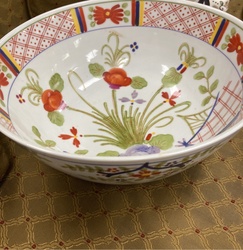
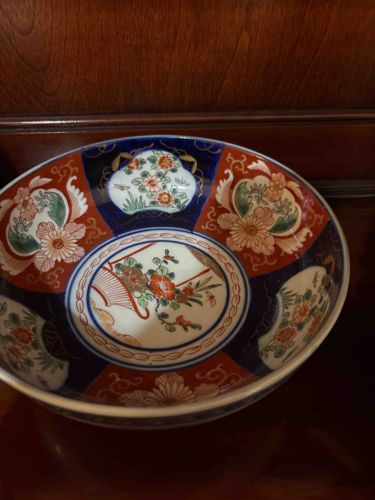
This is a circular porcelain bowl featuring a classic decorative scheme characteristic of Japanese Imari ware, produced in the Arita region. The piece showcases the traditional 'Imari' palette, which consists of underglaze cobalt blue, overglaze iron red, and touches of polychrome enamel alongside subtle gilding elements. The interior is divided into alternating radial panels of deep blue and reddish-orange, each containing cartouches. These cartouches are meticulously decorated with various botanical motifs, including chrysanthemums and peonies, which are common symbols in Japanese art. The central well of the bowl contains a circular medallion depicting a 'hanakago' or flower basket, surrounded by a double-ring geometric border in iron red. The construction is of fine hard-paste porcelain with a smooth, glazed finish. In terms of condition, the piece appears well-preserved with vibrant colors, though there are minor instances of wear on the overglaze enamels and gilding, consistent with age. There is a slight visible patina on the glaze surface, but no major chips, cracks, or structural repairs are immediately evident. This style of porcelain was extensively exported to Europe starting in the late 17th century; however, this specific bowl likely dates from the late 19th-century Meiji era (1868-1912) based on the saturation of the pigments and the density of the pattern. The craftsmanship illustrates high quality with consistent brushwork and a balanced composition typical of traditional Arita kilns.
AI-Generated Appraisal Disclaimer
Estimated Value
$150 - $250
Basic Information
Category
Asian Art - Ceramics and Porcelain
Appraised On
December 20, 2025
Estimated Value
$150 - $250
Item Description
This is a circular porcelain bowl featuring a classic decorative scheme characteristic of Japanese Imari ware, produced in the Arita region. The piece showcases the traditional 'Imari' palette, which consists of underglaze cobalt blue, overglaze iron red, and touches of polychrome enamel alongside subtle gilding elements. The interior is divided into alternating radial panels of deep blue and reddish-orange, each containing cartouches. These cartouches are meticulously decorated with various botanical motifs, including chrysanthemums and peonies, which are common symbols in Japanese art. The central well of the bowl contains a circular medallion depicting a 'hanakago' or flower basket, surrounded by a double-ring geometric border in iron red. The construction is of fine hard-paste porcelain with a smooth, glazed finish. In terms of condition, the piece appears well-preserved with vibrant colors, though there are minor instances of wear on the overglaze enamels and gilding, consistent with age. There is a slight visible patina on the glaze surface, but no major chips, cracks, or structural repairs are immediately evident. This style of porcelain was extensively exported to Europe starting in the late 17th century; however, this specific bowl likely dates from the late 19th-century Meiji era (1868-1912) based on the saturation of the pigments and the density of the pattern. The craftsmanship illustrates high quality with consistent brushwork and a balanced composition typical of traditional Arita kilns.
Related Tags
Get Your Items Appraised
Instant estimates of your treasures with AI-powered instant appraisals