Chert Hand Axe or Lithic Core
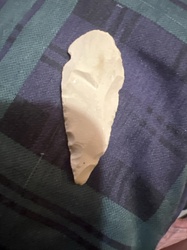
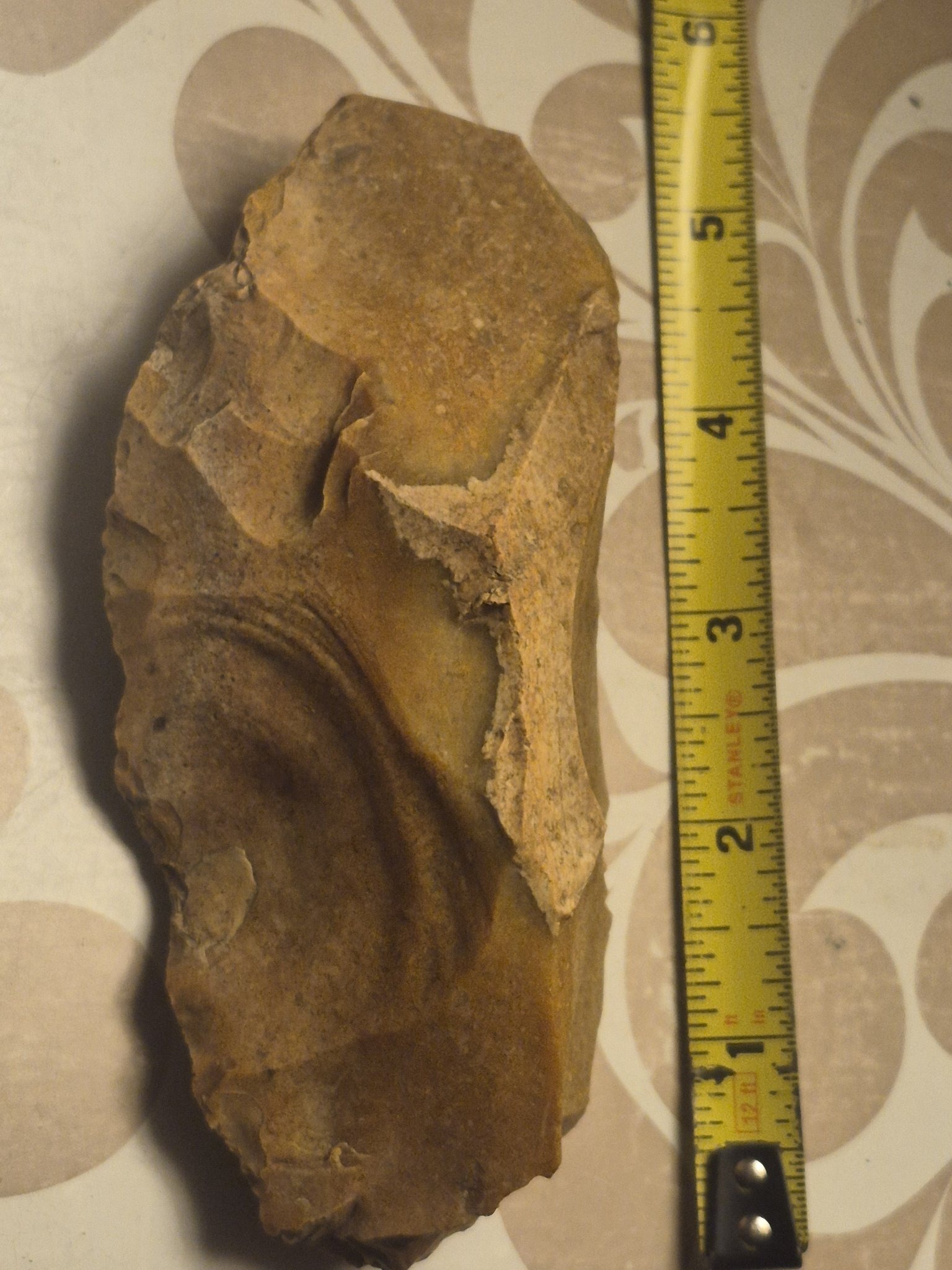
This item is a lithic artifact, likely a large hand axe or a prepared core, measuring approximately 5.75 inches in total length. It is fashioned from a silicate sedimentary rock, likely chert or flint, displaying a tan to yellowish-brown coloration. The artifact exhibits extensive percussion flaking along the margins, characteristic of stone tool manufacturing. Notable bulb of percussion and ripples are visible on the ventral surface, indicating where flakes were intentionally struck during its creation. Portions of the original limestone or chalky cortex remain visible, particularly on the right-hand ridge, providing a textural contrast between the weathered outer 'skin' of the raw material and the smoother, knapped interior. Geologically, the material shows signs of significant age with a deep patina. Condition-wise, there appears to be some modern edge damage or 'plow scars' on the mid-section, indicated by fresher, lighter-colored crushes compared to the heavily patinated older flake scars. The craftsmanship is utilitarian, reflecting a Middle to Upper Paleolithic or Archaic style, used for heavy-duty tasks like butchering or wood processing, or as a nucleus from which smaller tools were struck.
AI-Generated Appraisal Disclaimer
Estimated Value
$75 - $150
Basic Information
Category
Archeological Artifacts / Native American Tools
Appraised On
May 11, 2026
Estimated Value
$75 - $150
Item Description
This item is a lithic artifact, likely a large hand axe or a prepared core, measuring approximately 5.75 inches in total length. It is fashioned from a silicate sedimentary rock, likely chert or flint, displaying a tan to yellowish-brown coloration. The artifact exhibits extensive percussion flaking along the margins, characteristic of stone tool manufacturing. Notable bulb of percussion and ripples are visible on the ventral surface, indicating where flakes were intentionally struck during its creation. Portions of the original limestone or chalky cortex remain visible, particularly on the right-hand ridge, providing a textural contrast between the weathered outer 'skin' of the raw material and the smoother, knapped interior. Geologically, the material shows signs of significant age with a deep patina. Condition-wise, there appears to be some modern edge damage or 'plow scars' on the mid-section, indicated by fresher, lighter-colored crushes compared to the heavily patinated older flake scars. The craftsmanship is utilitarian, reflecting a Middle to Upper Paleolithic or Archaic style, used for heavy-duty tasks like butchering or wood processing, or as a nucleus from which smaller tools were struck.
Get Your Items Appraised
Instant estimates of your treasures with AI-powered instant appraisals