AI Appraisal Estimate

AI-generated estimates · not official valuations

From the user

What was submitted

Photo and notes provided by the user — not generated by AI

Submitted item photo
Submitted photo · May 30, 2026

User's notes

No additional notes provided.

AI analysis below

AI appraisal

AI analysis & estimate

AI-Generated · Verify before acting

Everything below is generated by AI for informational purposes only. AI can make mistakes — the AI may misidentify items or misattribute them (artist, maker, brand, designer, origin, era). This is not an official valuation and should not be used for insurance, sale, tax, estate, legal, or lending purposes — or any decision requiring a certified appraisal. It is not an authoritative claim about any person, brand, or rights holder — do not share or rely on it as a factual statement about a third party. Always consult qualified professionals before making financial decisions.

Read the full disclaimer

AI Identification

·Not independently authenticated·Verify before acting

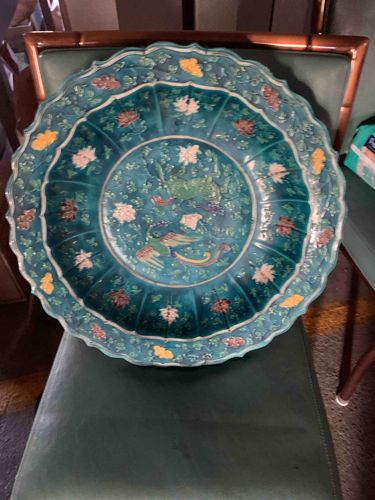
Chinese Turquoise-Ground Famille Verte Scalloped Charger

Asian Antiques - Chinese Ceramics

AI Estimated Value

·Not an official valuation·Verify before acting

$1,800 - $2,500

As of May 30, 2026

AI Item Analysis

·AI can make mistakes·Verify before acting
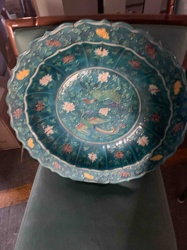
This is a large, ornate Chinese porcelain charger featuring a deep turquoise enamel ground, characteristic of late Qing Dynasty or early 20th-century Republic period export ware. The piece is notable for its lobed, scalloped rim and a molded 'fluted' or 'chrysanthemum' body that creates a sense of movement across the surface. The central medallion depicts a mythical scene, likely featuring a phoenix and other songbirds among flowering peonies and rocky outcrops, rendered in the 'Famille Verte' palette (dominated by greens, yellows, and iron-reds). The cavetto is divided into radiating sections, each containing individual floral sprays like lotus and plum blossoms. The exterior rim repeats a floral scroll motif. In terms of craftsmanship, the enamels appear thickly applied with visible texture. While the overall structure remains intact, there is visible surface wear to the enamel, particularly on the raised ribs of the fluting, and possible minor fritting or small chips along the delicate scalloped edge. The rich turquoise hue suggests a specialized kiln firing, and the scale indicates it was intended as a significant decorative display piece rather than for utilitarian use.
AI Appraisal Report

·AI can make mistakes·Verify before acting
Based on my visual examination of this Turquoise-Ground Famille Verte Scalloped Charger, I identify it as a high-quality example of Late Qing Dynasty to early Republic period (c. 1880–1920) porcelain. The use of the 'Kangxi revival' style, characterized by the Famille Verte palette against a dense turquoise enamel, suggests a provenance associated with the export market but produced at a time of increasing technical refinement. The scalloped, chrysanthemum-molded body is a labor-intensive feature that adds significant aesthetic value. The condition shows typical age-related wear. I note visible thinning of the enamel on the raised fluting and minor fritting along the rim, which is expected for porcelain of this age. However, the integrity of the central phoenix motif remains largely preserved. The bold coloration and large scale make this a highly desirable decorative piece for modern collectors of Asian arts. Market demand for late 19th-century enamel wares remains stable, with similar scalloped chargers appearing in major auction houses. Comparables suggest that while it lacks the ultra-premium value of genuine early Kangxi pieces, the 'export chic' appeal maintains a firm secondary market price. Limitations: My assessment is based solely on digital images. A definitive valuation and authentication would require a physical inspection to examine the foot rim for correct clay composition, check for hidden hairline fractures using UV light, and verify the weight and translucency of the paste. Absence of a reign mark is common for this period, but any provenance documentation or evidence of the piece belonging to a recognized collection would significantly increase its marketability.

Get your items appraised

Instant estimates of your treasures with AI-powered appraisals

Browse More Appraisals