These notes were written by the person who submitted this item. Appraiser.AI has not verified them, and the AI's identification and estimate may rely on them.
AI Estimated Value
Not an official valuation
$600-900
AI estimate as of October 29, 2025 · verify with a professional before acting
AI-Generated · Verify before acting
Everything on this page is generated by AI for informational purposes only. AI can make mistakes — the AI may misidentify items or misattribute them (artist, maker, brand, designer, origin, era). This is not an official valuation and should not be used for insurance, sale, tax, estate, legal, or lending purposes — or any decision requiring a certified appraisal. It is not an authoritative claim about any person, brand, or rights holder — do not share or rely on it as a factual statement about a third party. Always consult qualified professionals before making financial decisions.
This analysis also relies on unverified notes provided by the user, which may be incomplete or inaccurate and could affect the result.
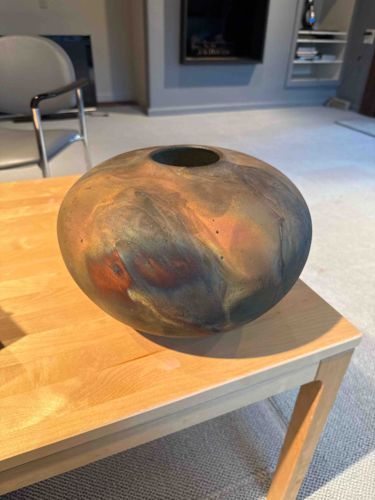
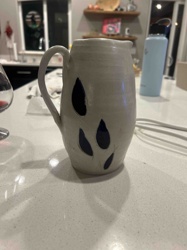
This is a spherical, Raku fired ceramic vessel, identified as piece number 483 by the artist Evans, indicated by the provided context. The vessel features a striking, iridescent glaze with a complex interplay of colors including deep blues, rich coppers, earthy browns, and hints of fiery red and orange. These colors swirl together in an organic, marbled pattern, characteristic of the Raku firing process which involves rapid cooling and reduction, creating unique metallic and smoky effects. The surface appears to have a subtle sheen but is not overtly glossy, which is typical for Raku. The form is a squat, globular shape with a relatively small, circular opening at the top, suggesting it is more of a decorative art piece than a functional vase for holding many flowers. The rim of the opening appears somewhat irregular, hinting at the handmade nature of the piece. While no specific dimensions are discernible from the image, it appears to be a substantial size, possibly a center-table piece. There are no visible chips, cracks, or repairs, and the overall condition appears excellent, showcasing the intended aesthetic of the Raku technique. The craftsmanship is evident in the controlled execution of the Raku process, resulting in a visually dynamic and sophisticated surface. This piece likely dates from the latter half of the 20th century or early 21st century, consistent with the modern studio pottery movement.
AI Appraisal Report
I have examined the provided image of the Raku fired studio pottery vessel by Evans, piece number 483. Visually, the condition appears excellent, with no discernible chips, cracks, or repairs. The vibrant iridescent glaze, featuring blues, coppers, browns, and reds, is characteristic of a well-executed Raku firing, suggesting good craftsmanship. The organic, marbled pattern and subtle sheen are consistent with the technique.
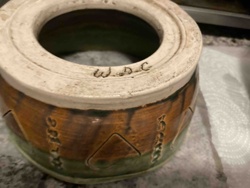
Establishing definitive authenticity solely from images is challenging. While the 'Evans 483' inscription provides a strong lead, a physical examination would be crucial to verify the signature or artist's mark, assess the tactile quality of the ceramic, and confirm the Raku firing process. Provenance documentation, such as purchase receipts or exhibition history, would further strengthen authenticity and directly link the piece to the artist. In-person inspection would also allow for precise measurements and a detailed assessment of the rim and interior.
In terms of market conditions, contemporary Raku pottery by recognized studio artists generally commands a good price, particularly for well-fired, visually striking pieces like this one. Evans, while not a household name in the broader art market, appears to be a skilled practitioner within the studio pottery community given the quality observed. The unique iridescent effects and complex coloring contribute significantly to its aesthetic appeal and marketability. Demand for handcrafted, unique art objects remains stable among collectors. Given its decorative nature, it appeals to those seeking distinctive centerpieces or conversation starters. The rarity is inherent to Raku, as each firing produces unique results, making '483' a one-of-a-kind piece. Considering the compelling visual qualities and assuming authentication through further inquiry, I estimate its value to be in the range of $600-$900.