AI Appraisal Estimate

AI-generated estimates · not official valuations

From the user

What was submitted

Photo and notes provided by the user — not generated by AI

Submitted item photo
Submitted photo · June 6, 2026

User's notes

No additional notes provided.

AI analysis below

AI appraisal

AI analysis & estimate

AI-Generated · Verify before acting

Everything below is generated by AI for informational purposes only. AI can make mistakes — the AI may misidentify items or misattribute them (artist, maker, brand, designer, origin, era). This is not an official valuation and should not be used for insurance, sale, tax, estate, legal, or lending purposes — or any decision requiring a certified appraisal. It is not an authoritative claim about any person, brand, or rights holder — do not share or rely on it as a factual statement about a third party. Always consult qualified professionals before making financial decisions.

Read the full disclaimer

AI Identification

·Not independently authenticated·Verify before acting

Art Nouveau French Spelter Bust of a Young Woman

Antique Sculpture & Fine Art

AI Estimated Value

·Not an official valuation·Verify before acting

$450 - $650

As of June 6, 2026

AI Item Analysis

·AI can make mistakes·Verify before acting
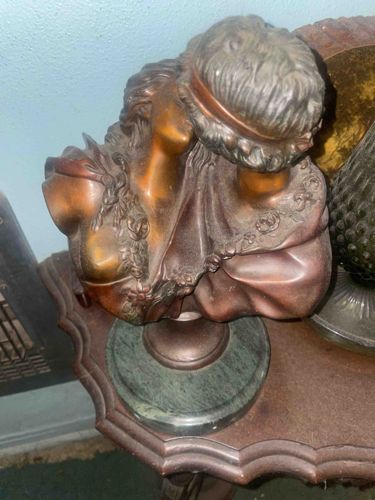
This is a decorative table-top bust sculpture, likely cast in spelter (white metal) with a classic bronze-toned patinated finish. The figure depicts a young woman in the Art Nouveau style, characterized by sweeping organic lines and floral motifs. She is portrayed in a romanticized pose, wearing a decorative headband and a garment adorned with a garland of sculpted flowers across the shoulder and chest. The sculpture is mounted on a circular green marble plinth, which provides structural stability and a classic contrast to the reddish-brown metal finish. Physically, the piece shows a heavy accumulation of surface dust and grime, particularly in the recessed areas of the hair and floral details, which obscures the finer texture of the casting. There are visible areas of wear on the high points of the patina, revealing the lighter-colored base metal beneath, which is a common characteristic of spelter pieces from the late 19th to early 20th century (circa 1890-1920). While no specific maker's marks are visible from this angle, the style is reminiscent of French 'Art Nouveau' producers like Auguste Moreau or Hippolyte Francois Moreau, though it is likely an unsigned production piece from that era. The craftsmanship shows moderate detail in the drapery and facial features, though the wear on the finish suggests it has seen significant display life. The attachment between the metal bust and the marble base appears secure, though the metal mounting stem shows some oxidation. Overall, the piece captures the idealized feminine beauty and botanical themes synonymous with the 'Belle Époque' period.

AI Appraisal Report

·AI can make mistakes·Verify before acting
Upon visual inspection of this Art Nouveau bust, I identify it as a late 19th to early 20th-century decorative casting, likely of French origin. The piece exhibits the fluid, botanical aesthetics of the Belle Époque, bearing stylistic hallmarks of the Moreau school. The use of spelter (white metal) rather than bronze is evidenced by the 'flaking' of the dark patina on high points, revealing the lighter metal beneath. While this material makes the piece more accessible than a true bronze, it remains highly collectible as an authentic period object. The condition is fair to good; the marble base is intact, and the casting detail remains sharp despite the heavy accumulation of dust and surface oxidation. Market demand for unsigned Art Nouveau spelter remains stable, though stagnant compared to signed works. Recent auction comparables for unsigned busts of this size and material typically range between $400 and $700 depending on the complexity of the casting. Value is currently constrained by the lack of a visible foundry mark or artist signature, as well as the surface wear. To reach a full authentication and potentially higher valuation, an in-person examination is required to check for hidden marks under the base or within the folds of the drapery. Scientific testing of the metal alloy (XRF) and an investigation into provenance or exhibition history would be necessary to elevate this from a 'production piece' to a 'work of art.' Investors should note that without a signature, the value relies primarily on decorative appeal rather than artist provenance.

Get your items appraised

Instant estimates of your treasures with AI-powered appraisals

Browse More Appraisals