Fossilized Vertebrate Jaw Fragment with Teeth
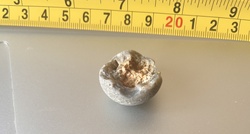
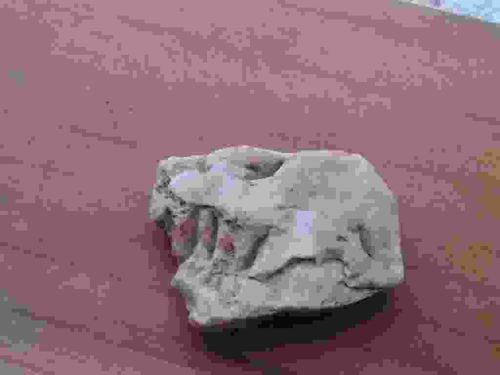
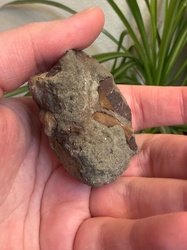
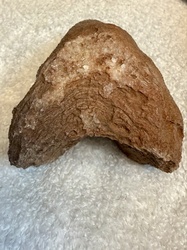
This specimen appears to be a fossilized portion of a mandible (lower jaw) or maxilla (upper jaw) from a small to medium-sized vertebrate, likely a mammalian species. The fragment exhibits a light tan to beige coloration, which is typical of mineral replacement in certain sedimentary environments. The physical construction shows several distinct anatomical features, most notably a series of fossilized teeth or dental alveoli (sockets) along one margin. The dental remains appear to be bunodont or possibly selenodont in morphology, suggesting a herbivorous or omnivorous mammal from the Cenozoic era. The bone matrix has a porous, vesicular texture consistent with fossilized cortical bone. There is notable weathering and mechanical erosion on the outer surfaces, likely due to exposure or transport in a fluvial environment before it was collected during rockhounding. No specific maker's marks exist as this is a natural specimen, but the quality of preservation for the dental root structure is fair. The age is estimated to be from the Paleogene or Neogene periods, though exact dating would require geological context from the find site. The specimen is roughly palm-sized and shows organic fracturing, with some reddish staining potentially from iron oxide in the surrounding soil.
AI-Generated Appraisal Disclaimer
Estimated Value
$150 - $250
Basic Information
Category
Paleontology / Natural History
Appraised On
February 19, 2026
Estimated Value
$150 - $250
Additional Details Provided By Owner
User Provided Information
found ro k hounding
Item Description
This specimen appears to be a fossilized portion of a mandible (lower jaw) or maxilla (upper jaw) from a small to medium-sized vertebrate, likely a mammalian species. The fragment exhibits a light tan to beige coloration, which is typical of mineral replacement in certain sedimentary environments. The physical construction shows several distinct anatomical features, most notably a series of fossilized teeth or dental alveoli (sockets) along one margin. The dental remains appear to be bunodont or possibly selenodont in morphology, suggesting a herbivorous or omnivorous mammal from the Cenozoic era. The bone matrix has a porous, vesicular texture consistent with fossilized cortical bone. There is notable weathering and mechanical erosion on the outer surfaces, likely due to exposure or transport in a fluvial environment before it was collected during rockhounding. No specific maker's marks exist as this is a natural specimen, but the quality of preservation for the dental root structure is fair. The age is estimated to be from the Paleogene or Neogene periods, though exact dating would require geological context from the find site. The specimen is roughly palm-sized and shows organic fracturing, with some reddish staining potentially from iron oxide in the surrounding soil.
Related Tags
Explore similar items and categories:
Get Your Items Appraised
Instant estimates of your treasures with AI-powered instant appraisals