AI Appraisal Estimate

AI-generated estimates · not official valuations

From the user

What was submitted

Photo and notes provided by the user — not generated by AI

Submitted item photo
Submitted photo · June 12, 2026

User's notes

No additional notes provided.

AI analysis below

AI appraisal

AI analysis & estimate

AI-Generated · Verify before acting

Everything below is generated by AI for informational purposes only. AI can make mistakes — the AI may misidentify items or misattribute them (artist, maker, brand, designer, origin, era). This is not an official valuation and should not be used for insurance, sale, tax, estate, legal, or lending purposes — or any decision requiring a certified appraisal. It is not an authoritative claim about any person, brand, or rights holder — do not share or rely on it as a factual statement about a third party. Always consult qualified professionals before making financial decisions.

Read the full disclaimer

AI Identification

·Not independently authenticated·Verify before acting

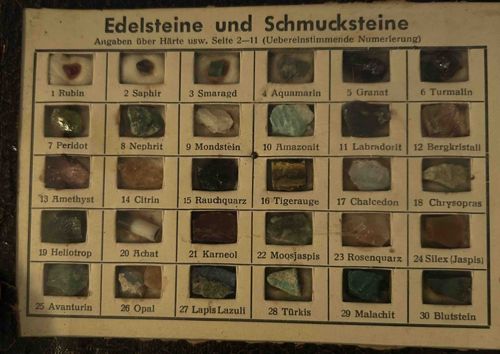
Vintage German Gemstone and Mineral Instructional Collection Box

Geological Collectibles / Educational Materials

AI Estimated Value

·Not an official valuation·Verify before acting

$150 - $250

As of June 12, 2026

AI Item Analysis

·AI can make mistakes·Verify before acting
This is a vintage educational gemstone collection presented in a rectangular cardboard display box titled 'Edelsteine und Schmucksteine' (Precious and Semi-precious stones). The display features thirty distinct mineral specimens, each housed in individual recessed square compartments arranged in a 5x6 grid. The specimens are raw, unpolished fragments representative of their mineral group. Notable varieties include Rubin (Ruby), Saphir (Sapphire), and Smaragd (Emerald) in the top row, moving through common minerals like Tigerauge (Tiger's Eye), Malachit (Malachite), and Lapis Lazuli. The board text is in German, indicating a mid-20th-century European educational origin, likely from between 1940 and 1960. The typeface is a clear sans-serif, and the header references a manual or guidebook (Seite 2-11). Physically, the cardstock shows significant age-related yellowing (patina) and light peripheral wear. The specimens appear generally intact, though some may have shifted or disintegrated slightly over time, leaving dust within the wells. The craftsmanship is utilitarian, designed for geological study or amateur collectors rather than high-end jewelry display. The set provides a comprehensive overview of mineral hardness and aesthetic variety as once taught in a scientific context.

AI Appraisal Report

·AI can make mistakes·Verify before acting
Upon visual examination of this German 'Edelsteine und Schmucksteine' instructional box, I find it to be an authentic piece of mid-century scientific ephemera, likely manufactured in the 1950s for schoolroom or amateur study. The collection features 30 specimens, including precious corundum and beryl variants alongside common silicates. The condition is consistent with age; the paperboard displays a natural amber patina and structural softening at the edges. While the specimens appear original to the housing, some minor 'mineral migration' or shedding is evident in the compartments. Markets for vintage geological educational materials have seen a steady rise due to their aesthetic appeal in 'Curiosity Cabinet' style interior design. Comparable German mineral sets of this era typically realize between $125 and $300 depending on the completeness of the set and the presence of the elusive accompanying guidebook referenced in the header. The value is driven primarily by the historical and graphic charm rather than the gemological value of the raw fragments. It must be noted that this appraisal is based on photographic evidence alone. A definitive valuation would require in-person inspection to verify that the higher-value specimens, such as the Ruby (Rubin) and Emerald (Smaragd), are genuine mineral fragments rather than synthetic glass substitutes—a common practice in cheaper educational kits. Furthermore, microscopic analysis would be needed to ensure no specimens have been re-glued or replaced with modern materials. Documentation regarding the specific German publisher or a bill of sale would further solidify its provenance and market desirability.

Get your items appraised

Instant estimates of your treasures with AI-powered appraisals

Browse More Appraisals